The Definitive Guide to AWS ASG Warm Pools

AWS EC2 Auto Scaling Groups (ASG) play a crucial role in managing the scalability and availability of applications by automatically adjusting the number of Amazon EC2 instances based on demand. ASGs ensure that the right number of instances are running to handle the load, scaling up during traffic spikes and scaling down when demand decreases. However, traditional scaling methods can introduce latency due to the time required to launch and initialize new instances.

This is where AWS EC2 Auto Scaling Warm Pools come into play. Warm pools allow pre-initialized EC2 instances to remain ready to quickly enter service when demand increases, significantly reducing the lag that often accompanies scaling events. By having instances in a warm state, organizations can ensure faster response times while optimizing costs, especially during high-demand scenarios.

The purpose of this guide is to provide a comprehensive understanding of AWS ASG Warm Pools, including their benefits, how they work, and best practices for implementation. Whether you’re new to auto-scaling or looking to optimize your current infrastructure, this guide will help you maximize efficiency with AWS warm pools.

What is AWS Auto Scaling Group (ASG)?

An AWS EC2 Auto Scaling Group (ASG) is a feature within AWS that automatically adjusts the number of Amazon EC2 instances in a fleet to match the current demand. This means that ASGs help ensure your applications have the right amount of compute resources at all times, scaling up when traffic increases and scaling down during low demand to save costs.

Key Benefits of Using ASGs

  1. Automated Scaling: ASGs ensure that your application is always running the optimal number of instances. This automation reduces manual intervention, improves reliability, and minimizes costs.
  2. High Availability: By distributing instances across multiple Availability Zones, ASGs help maintain application availability, even in the event of failure in one zone.
  3. Cost Efficiency: ASGs enable efficient resource management by scaling down during off-peak hours, leading to significant cost savings.

Key Components of ASGs

  • Launch Configurations or Launch Templates: These define the instance type, AMI, and other parameters that ASG uses to launch new EC2 instances.
  • Scaling Policies: These determine how and when ASG should scale, based on metrics such as CPU utilization, memory usage, or custom-defined triggers.
  • Health Checks: ASG performs regular checks to ensure that instances are healthy. Unhealthy instances are automatically replaced.

What are Warm Pools in AWS ASG?

Warm pools are an advanced feature of AWS ASG designed to reduce the time it takes to scale out an application. Unlike traditional ASG instances, which are either fully active (serving traffic) or cold (completely terminated), warm pools allow instances to exist in a pre-initialized state. This means they can be quickly transitioned into service without the delay of instance boot time and initialization.

Difference Between Warm Pools and Cold/Active Instances

  • Cold Instances: These are fully terminated and require a longer time to boot and initialize before they can serve traffic.
  • Active Instances: These are running and serving traffic as part of your ASG.
  • Warm Pool Instances: These remain in a partially initialized state, reducing the time required to activate them compared to cold instances.

Key Benefits of Using Warm Pools

  1. Faster Scaling: Pre-initialized instances in the warm pool can be quickly moved to active service, drastically reducing the time needed to respond to sudden traffic spikes.
  2. Cost Savings: You can maintain instances in the warm pool at a lower cost than fully running instances, allowing for better cost management while ensuring rapid scalability.
  3. Improved User Experience: By minimizing the delay during scaling events, warm pools help ensure that user requests are handled more efficiently, especially during peak loads.

How Do AWS Warm Pools Work?

AWS Warm Pools allow Auto Scaling Groups to maintain a pool of pre-initialized EC2 instances that can be quickly brought online to serve traffic. Instead of launching brand-new instances from scratch, warm pools enable instances to remain in a “warm” state, ready to be activated in response to scaling needs. This helps reduce the time it takes to scale out, improving performance during traffic spikes.

Lifecycle of Instances in Warm Pools

Instances in an AWS Warm Pool go through several stages:

  1. Warm: Instances are pre-initialized and kept in a warm state but are not yet serving traffic. They can be in either a “stopped” or “running” state.
    • Stopped: Instances are launched and initialized but are then stopped, reducing costs since you only pay for storage. When scaling is needed, they must first be restarted before entering service.
    • Running: Instances are initialized and kept running but aren’t actively serving traffic. They can be moved into service more quickly than stopped instances.
  2. In-Service: Instances are actively serving traffic as part of the Auto Scaling Group.
  3. Terminated: Instances that are no longer needed are terminated and removed from the warm pool.

Cost Savings and Performance Advantages

  1. Cost Savings: Stopped instances in the warm pool incur only storage costs (such as EBS volumes), which are lower than the costs of fully running instances. This allows you to have spare capacity ready without paying for full instance time.
  2. Performance Gains: When traffic spikes occur, moving a pre-initialized instance from the warm pool into service is faster than launching a new instance from scratch. This reduces latency and improves the speed of scaling events, ensuring your applications can handle sudden surges in traffic with minimal delay.

How to Set Up Warm Pools in AWS ASG

Setting up warm pools in an Auto Scaling Group is relatively straightforward and can be done using either the AWS Management Console, AWS CLI, or SDKs.

Step-by-Step Instructions

  1. Navigate to the Auto Scaling Groups in the AWS Management Console.
    • Go to the EC2 Dashboard.
    • Select Auto Scaling Groups from the left-hand menu.
  2. Select or Create an ASG:
    • If you already have an ASG, select it from the list.
    • To create a new ASG, click Create Auto Scaling Group and follow the setup wizard.
  3. Configure the Warm Pool:
    • Once you’ve selected the ASG, click on the Warm Pool tab.
    • Click Add Warm Pool.
  4. Set the Warm Pool Size:
    • Specify how many instances should be maintained in the warm pool.
    • Choose whether instances should be kept in a stopped or running state when they are in the warm pool.
  5. Specify the Instance Reuse Policy:
    • Choose whether to reuse terminated instances by adding them to the warm pool, or allow them to be fully terminated when scaling down.
  6. Apply and Save the Configuration.

Key Configuration Options

  • Size of the Warm Pool: Define the number of instances to keep in the warm pool.
  • Stopped vs. Running State: Choose between keeping instances stopped (cheaper but slower to activate) or running (more expensive but faster to activate).
  • Reuse Policy: Decide whether to reuse instances after termination by moving them back into the warm pool.

Example Configuration Code Using AWS CLI

You can set up a warm pool using the AWS CLI with the following command:

In this example:

  • The warm pool is associated with an Amazon EC2 Auto Scaling Group called my-asg.
  • The warm pool keeps 2-5 instances in a running state, and terminated instances are reused.

These simple steps and configuration options will enable you to integrate warm pools into your AWS ASG for improved performance and cost optimization.

Best Practices for Using AWS ASG Warm Pools

To fully leverage the potential of AWS ASG Warm Pools, it’s important to tailor configurations based on your specific use cases, monitor your pools effectively, and ensure smooth handling of instance failures.

Optimal Configurations for Different Use Cases

  • High-Traffic Applications: For workloads with frequent, unpredictable traffic spikes (e.g., e-commerce sites or streaming services), keeping instances in a running state within the warm pool ensures the fastest response time.
  • Predictable Traffic Patterns: For applications with known traffic patterns (e.g., batch processing or seasonal demand), instances in a stopped state offer a good balance between cost and readiness. Instances can be spun up in advance when higher demand is expected.
  • Cost-Conscious Environments: If your focus is primarily on cost control, configure a minimal warm pool size and keep instances stopped to reduce costs while maintaining some capacity to respond quickly.

Monitoring and Managing Warm Pools

Effective monitoring is essential to ensure that warm pools are functioning optimally:

  • CloudWatch Metrics: Use Amazon CloudWatch to track key metrics like warm pool size, instance state (stopped or running), and the time taken to move instances into service. This will help ensure that your warm pool configuration is aligned with your performance goals.
  • Scaling Events: Regularly review scaling events to assess how well your warm pools are handling traffic spikes and whether adjustments are needed to pool size or instance state.
  • Health Checks: Automate health checks to ensure that instances in the warm pool are ready to serve traffic when needed. Unhealthy instances should be replaced promptly to prevent any disruptions during scaling events.

Handling Instance Failures and Recovery in Warm Pools

  • Instance Replacement: If an instance in the warm pool fails, ASG will automatically terminate and replace it. Ensure your warm pool is configured to handle instance failures efficiently by setting the reuse policy to prevent the re-use of unhealthy instances.
  • Lifecycle Hooks: Utilize ASG lifecycle hooks to add custom actions during the instance startup process, such as validating configurations before moving instances from the warm pool to in-service.

Cost Considerations and Optimization for Warm Pools

AWS Warm Pools can offer significant cost savings compared to traditional scaling methods, but it’s essential to optimize their use to balance cost and performance.

How Warm Pools Impact AWS Costs

The primary cost consideration for warm pools is the difference between instances in a stopped state and those in a running state:

  • Stopped Instances: You only incur storage costs (such as EBS volumes) for stopped instances in the warm pool. This can lead to considerable savings, especially if you have a large warm pool.
  • Running Instances: While running instances in a warm pool provide faster activation times, they continue to accrue instance costs even when not actively serving traffic. This makes them more expensive than stopped instances.

Strategies for Cost Optimization Using Warm Pools

  1. Right-Size Your Warm Pool: Avoid over-provisioning. Carefully analyze your traffic patterns and use historical data to determine the optimal number of instances to keep in the warm pool. Maintaining an unnecessarily large warm pool leads to wasted costs.
  2. Use a Mix of Stopped and Running Instances: Depending on the criticality of your application, a hybrid approach can help balance performance with cost. For example, you can maintain a small number of running instances for instant scaling and a larger number of stopped instances for cost-efficiency.
  3. Leverage Spot Instances: For additional cost savings, you can combine spot instances with warm pools to benefit from AWS’s lower pricing model. However, be mindful of the risk that spot instances might be interrupted.

Balancing Cost with Performance Benefits

Finding the right balance between cost and performance is key to maximizing the value of warm pools.

  • Critical Applications: If minimizing latency during scaling is crucial for user experience (e.g., real-time services), prioritize performance by keeping more running instances in the warm pool.
  • Less Time-Sensitive Applications: For workloads where minor scaling delays are acceptable, keeping more stopped instances is a smart way to reduce costs without sacrificing too much performance.

By carefully managing the size and state of your warm pools, you can optimize costs while still ensuring that your application can scale quickly when needed.

Conclusion

AWS ASG Warm Pools offer a powerful solution to accelerate scaling times while maintaining cost-efficiency. By pre-initializing instances, you can drastically reduce the latency involved in launching new EC2 instances, ensuring your applications can handle sudden traffic spikes seamlessly. Whether your goal is to enhance performance for mission-critical applications or to optimize costs for more predictable workloads, warm pools provide the flexibility to meet diverse scaling needs.

Key Benefits Recap:

  • Faster Scaling: Pre-warmed instances can enter service almost immediately, reducing delays during scaling events.
  • Cost Efficiency: With the ability to keep instances in a stopped state, you can maintain scalability readiness without incurring the full costs of running instances.
  • Improved User Experience: By minimizing downtime during scaling, you ensure your users receive a seamless experience, even during traffic surges.

Integrating warm pools into your AWS Auto Scaling strategy is a smart move for any business looking to balance performance with cost. By carefully configuring your warm pool size, state, and policies, you can optimize both response times and expenses.

Interested in seeing how AWS ASG warm pools can boost your cloud efficiency? Try setting up warm pools in your AWS ASG environment today and experience improved scalability and cost savings firsthand!


Comparing K0s vs K3s vs K8s: Key Differences & Ideal Use Cases

We prepared a comprehensive comparison of K0s vs K3s vs K8s, as Kubernetes has become the go-to solution for container orchestration and along with capabilities growth, various distributions have been developed to meet different user needs. We will explain their architectural differences, performance characteristics, disadvantages, and ideal use cases, helping you identify the right distribution for your specific needs.

Overview of K8s

Kubernetes, or K8s is the industry-standard platform for container orchestration. It automates the deployment, scaling, and management of containerized applications across clusters of machines. Kubernetes was designed to provide high availability and fault tolerance, ensuring that applications can scale horizontally, handle varying workloads, and self-heal in the case of failures.

Key Features and Capabilities of K8s

One of Kubernetes’ standout features is automatic bin packing, which efficiently places containerized workloads across available resources, ensuring optimal utilization. Self-healing is another critical feature, where failed containers are automatically restarted, and applications are rescheduled on new nodes if needed. Additionally, Kubernetes offers service discovery and load balancing, which routes traffic to containers through a DNS name or IP address, ensuring high availability.

Moreover, Kubernetes supports storage orchestration, enabling dynamic attachment of storage from various sources such as local disks, cloud storage, or network storage. It also excels in horizontal scaling, automatically adjusting the number of containers based on real-time metrics like CPU and memory utilization.

When to use k8s?

Kubernetes is widely used in microservices architectures, where applications are broken down into smaller, independently deployable services. It’s also ideal for cloud-native applications, allowing developers to build and manage large, scalable applications that run across hybrid and multi-cloud environments. Organizations often deploy Kubernetes in production environments to manage complex, distributed systems requiring high reliability and fault tolerance.

K8s disadvantages: when k3s is a better option

Despite the power k8s offers, it can be highly complex to set up and manage, particularly for smaller teams or organizations without extensive infrastructure expertise. Its resource-intensive nature means it requires significant CPU, memory, and storage, making it costly to operate, especially at scale. Additionally, managing K8s clusters often requires a steep learning curve, and troubleshooting can be challenging without deep knowledge of its components.

Kubernetes (K8s) is a powerful and feature-rich platform that serves as the backbone of modern cloud-native and microservices architectures. While it requires more resources and expertise to manage, it excels in complex, large-scale deployments. Its robust features make it a critical tool for organizations looking to scale applications reliably across diverse environments.

K3s explained

K3s is a lightweight Kubernetes distribution designed by Rancher Labs. It was created to run Kubernetes clusters in resource-constrained environments, without sacrificing the core Kubernetes API or functionality. By minimizing resource consumption and reducing complexity, K3s makes it possible to bring Kubernetes to edge computing, IoT environments, and development setups where full-scale Kubernetes deployments would be overkill.

Difference between k3s and k8s

K3s is different from k8s – it’s drastically smaller in size, as it eliminates unnecessary components like legacy add-ons and deprecated APIs. It also uses lightweight database solutions such as SQLite rather than the traditional etcd, which significantly reduces resource usage. In terms of architecture, K3s consolidates several processes, simplifying the control plane, and removing much of the complexity found in standard Kubernetes.

In addition to being easier to deploy and manage, K3s is designed to run on a variety of hardware, including ARM devices, which makes it highly suitable for IoT applications. This distribution offers a single binary installation, reducing setup time and making it accessible to developers and operators who need a Kubernetes cluster quickly.

When to use k3s over k8s

K3s shines in environments where resource efficiency is crucial, such as edge computing. It enables the deployment of Kubernetes on small devices or in remote locations where limited CPU and memory are available. In IoT environments, K3s can be used to manage clusters across numerous connected devices, all while keeping the overhead low. Additionally, it is perfect for local development environments, where developers need to spin up a Kubernetes cluster quickly for testing without the burden of configuring a full-fledged K8s setup.

Disadvantages of K3s

Although K3s is an excellent solution for lightweight and edge environments, it doesn’t scale as well as full Kubernetes for larger, production-grade workloads. K3s supports reduced feature set which means it lacks some of the more advanced capabilities of K8s, such as sophisticated network plugins or complex role-based access control (RBAC). Additionally, while K3s simplifies many operational processes, it may still present challenges for large-scale, multi-cluster management due to its streamlined nature.

K3s is a powerful alternative to Kubernetes for environments where resources are constrained. It maintains much of Kubernetes’ core functionality while offering simplicity and efficiency, making it ideal for edge computing, IoT, and development use cases. Its ease of setup and low resource requirements allow Kubernetes to be deployed in places where it previously wasn’t feasible. However, when choosing between k3s or k8s, its limitations in scalability and reduced feature set may hinder its use in more complex, production-scale environments.

K0s – a lightweight Kubernetes

K0s is a popular lightweight Kubernetes distribution developed by Mirantis, designed with a focus on simplicity and minimalism. It aims to provide a zero-friction experience for running Kubernetes clusters, stripping away much of the complexity that makes managing Kubernetes challenging. Like K3s, it is also lightweight, but brings additional modularity and flexibility, allowing users to customize their deployment to suit minimalistic environments or cloud-native applications.

Key differences between k3s, k8s vs k0s

K0s is packaged as a single binary, simplifying the installation process, much like K3s. However, one of its standout features is that it operates entirely in user space, meaning it doesn’t require any modifications to the underlying host system, reducing potential issues with host-level configurations. Additionally, it offers a modular design, allowing users to enable only the components they need, further reducing the operational overhead.

Another feature that sets K0s apart from k3s or k8s is its low memory and CPU footprint, making it an excellent choice for cloud-native applications or environments where keeping operational costs low is a priority. It retains Kubernetes’ API, ensuring compatibility with cloud-native tools and workflows while being easier to operate.

Ideal Use Cases

K0s is perfect for minimalistic deployments where you need Kubernetes but don’t want the complexity of a full-blown K8s setup. For example, in CI/CD pipelines, it can be used to spin up clusters for testing purposes quickly, without consuming significant resources. It is also a solid choice for cloud-native applications that prioritize low overhead while still needing Kubernetes orchestration. K0s is a lightweight, customizable Kubernetes environment, which provides the right balance between simplicity and power.

Disadvantages of K0s

While this distribution offers a minimalistic approach, this can be limiting in more demanding environments. It is not as widely adopted as K8s or K3s, meaning community support and ecosystem maturity are not as strong. This can result in fewer third-party tools, integrations, and plugins being available. Additionally, K0s’ modularity, while a benefit in terms of customization, may require more hands-on effort to configure correctly, especially for users unfamiliar with Kubernetes.

It delivers a minimalistic yet highly functional Kubernetes experience, making it ideal for cloud-native environments and minimal deployments. Its modular design, ease of setup, and reduced footprint make it a compelling option for developers and operators who want to use Kubernetes without the complexity associated with larger-scale deployments. However, its smaller community and lack of advanced features compared to K8s could be a disadvantage for users needing robust ecosystem support.

Detailed Comparison: K0s vs K3s vs K8s

Architecture and Resource Requirements: how all are different from k8s

K8s has a more complex architecture that includes a separate control plane and worker nodes, along with various supporting components such as etcd for state management. K3s simplifies this architecture by merging several processes and reducing its overall size. K0s, similarly, provides a consolidated control plane, but its architecture allows for greater modularity, enabling users to strip away non-essential components, thus reducing resource consumption.

K8s is resource-intensive but provides unmatched scalability and robustness for large deployments. K3s and K0s, on the other hand, offer more lightweight alternatives, with K3s focusing on simplicity and K0s emphasizing modularity. However, both K3s and K0s sacrifice some of the advanced features and scalability of K8s.

Setup and Management: advantages of k3s and k0s

K8s installations can be complex, often requiring a tool like kubeadm or a managed Kubernetes service to simplify the setup process. K3s, in contrast, is designed for quick, one-command installations, making it much easier for developers and small teams to get up and running. K0s provides a similarly simple installation experience, with the added advantage of being modular, allowing users to install only what they need.

When it comes to ease of setup, K3s and K0s excel over K8s, making them better suited for users who want a hassle-free experience without sacrificing key Kubernetes functionality. However, the simplicity of K3s and K0s comes at the cost of advanced configuration and management options found in full-fledged Kubernetes environments.

Performance and Scalability: k0s and k3s are different form k8s

K8s is known for its ability to scale to thousands of nodes, handling complex, high-traffic workloads with ease. K3s and K0s, while efficient, are designed for smaller-scale deployments and may struggle to meet the demands of large enterprise applications. However, for edge cases and low-resource environments, K3s and K0s are optimized to perform well under constrained conditions.

K8s outperforms K3s and K0s when it comes to large-scale, high-performance environments, but for smaller workloads and edge deployments, K3s and K0s provide more resource-efficient alternatives.

Security Features: k8s is best suited?

K8s has a robust security model, supporting role-based access control (RBAC), network policies, and various other security mechanisms. K3s includes many of these features but may not provide the same level of granularity as K8s. K0s offers basic security configurations but lacks some of the more advanced options available in K8s, making it less suitable for security-sensitive environments.

K8s may be the better choice in security features, providing the most comprehensive set of tools for managing secure, multi-tenant environments. K3s and K0s offer simpler security models, which may suffice for smaller, less complex deployments but could be a drawback in more secure environments.

Community and Ecosystem Support: k8s vs k3s

K8s benefits from a large, active community and an extensive ecosystem of third-party tools, integrations, and plugins. K3s, while smaller, still enjoys solid community support due to its close adherence to the Kubernetes API. K0s is newer and less widely adopted, which means its community and ecosystem are less mature compared to K8s and K3s.

K8s is a more feature-rich distribution and has the most extensive community and ecosystem support, which makes it easier to find help, tools, and integrations. K3s can help you quickly start and offers a middle ground, with a reasonable level of community engagement, while K0s is the distribution of Kubernetes lags in terms of third-party support.

In conclusion, K0s, K3s, and K8s each serve distinct purposes, with K8s standing out as the robust, enterprise-grade solution, while K3s and K0s cater to more specialized, lightweight use cases. Understanding the differences in architecture, resource usage, ease of management, and scalability can help you choose the best tool for your specific needs. As Kubernetes continues to evolve, these distributions will play an essential role in extending the power of Kubernetes to new environments and use cases. 

AWS Savings Plans Explained: Your Guide to Cost Efficiency

AWS Savings Plans are flexible pricing models that offer significant savings on Amazon Web Services (AWS) in exchange for a consistent usage commitment over one or three years. These plans are designed to help businesses optimize their cloud spending, allowing for cost reduction while maintaining performance and scalability.

Cost optimization has become essential in cloud computing, where resources can quickly become expensive if not managed effectively. In the previous CloudAvocado article, we have explored the key differences between Reserved Instances and Savings Plans, highlighting how Savings Plans offer more flexibility while still delivering substantial cost savings. Now, this guide will break them down for you, focusing on pricing structures, benefits, and comparisons with other models to help you make informed decisions.

What Are AWS Savings Plans?

AWS Savings Plans are pricing models that allow you to commit to a certain amount of compute usage over time, typically offering up to 72% savings compared to On-Demand instances. These plans cover various services, including EC2, AWS Lambda and AWS Fargate, and can be applied flexibly across regions and instance families.

In comparison to other AWS pricing models, such as On-Demand and Reserved Instances, Savings Plans offer a more adaptable approach. While Reserved Instances lock you into specific instance types and regions, Savings Plans provide flexibility, allowing businesses to switch between instance types or regions without losing benefits. This adaptability makes Savings Plans particularly appealing for businesses with evolving compute needs.

The main benefits of AWS Savings Plans include cost savings, flexibility across services, and ease of management, making them a compelling choice for organizations aiming to reduce their cloud spending.

Types of AWS Savings Plans

AWS Savings Plans are categorized into two main types: Compute Savings Plans and EC2 Instance Savings Plans. Each plan type caters to different use cases and levels of flexibility, allowing businesses to optimize their cloud spending based on their unique needs. Understanding the differences between these plans is essential for making an informed decision that aligns with your organization’s operational requirements and budget.

Compute Savings Plans

Compute Savings Plans offer the most flexibility among AWS Savings Plans, providing significant savings for users who need adaptable infrastructure. These plans apply to EC2, Lambda and Fargate usage and allow businesses to switch seamlessly between instance families, regions, and even operating systems (OS). This flexibility makes Compute Savings Plans ideal for companies that have dynamic or fluctuating workloads but still want to maintain cost efficiency.

For example, if your business needs to move workloads from one region to another or switch from one instance type to another as your needs evolve, Compute Savings Plans ensure you retain cost savings across these changes. The primary use case is for organizations seeking high flexibility without compromising on long-term cost benefits.

EC2 Instance Savings Plans

EC2 Instance Savings Plans, on the other hand, are more specific in their scope. These plans provide savings for users who can commit to a specific EC2 instance family in a particular region. Unlike Compute Savings Plans, which offer cross-region and cross-instance flexibility, EC2 Instance Savings Plans are tied to a particular instance family, such as C5, M5, or R5, and are best suited for businesses with more predictable workloads that don’t require frequent changes in infrastructure.

The trade-off for this specificity is deeper discounts compared to Compute Savings Plans. If your workloads remain consistent and you don’t need to switch instance types or regions, this plan can offer significant cost savings.

Amazon SageMaker Savings Plans

Amazon SageMaker Savings Plans provide cost savings specifically for machine learning workloads using Amazon SageMaker. These plans allow you to commit to a specific dollar-per-hour usage for SageMaker, offering flexibility across instance types, regions, and SageMaker services, with savings of up to 64% compared to On-Demand pricing. This plan is ideal for businesses running extensive machine learning models looking for long-term savings on their ML infrastructure.

How AWS Savings Plans Pricing Works

AWS Savings Plans operate on a commitment-based pricing model, where you agree to a specific usage level measured in dollars-per-hour for either one- or three-year term. The more you commit, the higher the discount, with savings of up to 72% compared to On-Demand pricing.

For instance, for AWS EC2 Savings Plans, the pricing breakdown is as follows:

  • 1-Year Commitment:
    • All Upfront: Offers the highest savings, with an average discount of up to 54%.
    • Partial Upfront: Requires a smaller upfront payment, with discounts of up to 42%.
    • No Upfront: Provides the most flexibility in payments, with a discount of around 30%.
  • 3-Year Commitment:
    • All Upfront: Discounts can reach up to 72%, making it the most cost-effective option for long-term, stable workloads.
    • Partial Upfront: A smaller upfront investment, but still offering substantial savings of around 59%.
    • No Upfront: Offers the convenience of monthly payments while achieving savings of up to 45%.

For Compute Savings Plans, the discounts are similar, offering a maximum of 66% savings over On-Demand pricing with a 3-year, All Upfront commitment.

AWS calculates your usage based on how much compute capacity you consume. For example, if you commit to a $10 per hour usage, AWS will apply Savings Plan discounts to any usage that fits within this amount. If you exceed the commitment, additional usage is charged at On-Demand rates.

Choosing the Right Savings Plan

When selecting the appropriate Savings Plan, it’s essential to consider your workload type and the predictability of your usage. If your workloads are highly variable, with frequent changes in instance types or regions, a Compute Savings Plan offers the flexibility you need. However, if your workload is stable, operating within a specific instance family and region, an EC2 Instance Savings Plan may be more beneficial due to the deeper discounts.

For example, businesses with applications requiring consistent performance, such as databases running on specific EC2 instance types, would benefit from EC2 Instance Savings Plans. Meanwhile, dynamic web applications with fluctuating resource requirements across regions are better suited to Compute Savings Plans.

Scenarios:

  • Compute Savings Plan: A startup that frequently adjusts its cloud infrastructure due to scaling demands and changes in traffic.
  • EC2 Instance Savings Plan: A media streaming platform that runs on a predictable set of instances within one region.

How to Purchase and Manage AWS Savings Plans

Purchasing an AWS Savings Plan is simple and can be done in a few steps:

  1. Log in to your AWS Cost Management Console.
  2. Navigate to “Billing” and select “Savings Plans” from the menu.
  3. Select the type of Savings Plan you need—either Compute Savings Plans or EC2 Instance Savings Plans—based on your workload requirements.
  4. Configure the plan details, including your desired hourly commitment level, term length (1-year or 3-year), and payment option (All Upfront, Partial Upfront, or No Upfront).
  5. Review your selections and confirm your purchase.

Once purchased, it’s important to regularly monitor your usage through AWS Cost Explorer, which provides detailed insights into how your savings plan is being applied. If you notice that your actual usage diverges from your committed spend, adjustments or plan modifications can be made during renewal or by purchasing an additional Savings Plan to cover excess usage.

AWS Savings Plans are an excellent way to optimize your cloud costs, offering flexibility for dynamic workloads or deeper discounts for predictable usage. By understanding the various Savings Plan options and carefully choosing the one that matches your business needs, you can achieve significant cost savings while maintaining operational efficiency.

To explore AWS Savings Plans and start reducing your cloud costs, consider consulting with an AWS expert or visiting the AWS Savings Plans page for more detailed guidance.

AWS S3 costs explained: Comprehensive pricing guide

Understanding how AWS S3 costs work can be complex due to the variety of pricing rules that depend on type, class, volume etc. Yet, Amazon Simple Storage Service (S3) is one of the most widely used cloud storage services, offering scalable, secure, and reliable storage for various data needs. That’s why navigating the costs associated with AWS S3 can feel overwhelming, especially as your storage needs grow and become more complex.

You might start by storing a few gigabytes, but before you know it, you’re dealing with terabytes of data across multiple regions, each with its own cost implications. Without a solid understanding of how AWS S3 pricing works, you could find yourself facing unexpected charges that quickly add up, affecting your budget and, ultimately, your bottom line.

This guide aims to demystify AWS S3 pricing by breaking down the various components that contribute to your overall costs. We’ll explore everything from storage classes and data transfer fees to the hidden costs of requests and replication. Whether you’re new to AWS S3 or looking to optimize your existing setup, this comprehensive guide will help you make informed decisions that align with your financial goals.

By the end of this guide, you’ll have a clearer picture of how to balance cost-efficiency with performance, reliability, and security. Let’s dive in and explore the key factors that influence AWS S3 pricing, so you can manage your cloud storage with confidence and clarity.

Overview of AWS S3

AWS S3 is designed to store and retrieve any amount of data from anywhere on the web. It is a highly durable and available object storage service that supports a range of use cases, from backup and restore to big data analytics. With features like versioning, lifecycle policies, and cross-region replication, AWS S3 provides a robust storage solution that can meet the needs of businesses of all sizes. The service is also integrated with various AWS tools, making it easier to manage and scale your storage as your data grows.

AWS S3 Pricing Components

Understanding the components that contribute to AWS S3 storage costs is crucial for managing your cloud budget effectively. AWS S3 pricing is divided into several categories:

  • Storage Pricing: This is the cost associated with storing your data. The price varies depending on the S3 storage class you choose, with options ranging from the more expensive Standard class to the cost-efficient Glacier Deep Archive.
  • Request and Data Retrieval Pricing: AWS charges for the number and type of requests you make to your S3 buckets. This includes GET, PUT, COPY, and LIST requests, as well as data retrieval costs, especially when accessing data stored in archival classes like Glacier.
  • Data Transfer Pricing: Data transfer costs depend on the amount of data moved between S3 and the internet or other AWS regions. While inbound data transfers to S3 are generally free, outbound transfers can incur significant charges.
  • Management and Replication Pricing: Costs associated with additional features like S3 Object Lambda, S3 Transfer Acceleration, and replication services also contribute to your overall S3 expenses.

Storage Classes and Their Pricing

AWS S3 offers several storage classes, each with its pricing structure:

  • Standard: The default storage class designed for frequently accessed data. It offers high durability and availability, with a moderate price point.
  • Intelligent-Tiering: This class automatically moves data between two access tiers (frequent and infrequent) based on changing access patterns, offering a cost-effective solution for data with unpredictable access patterns.
  • Standard-IA (Infrequent Access): Ideal for data that is accessed less frequently but requires rapid access when needed. It is priced lower than the S3 Standard class but incurs retrieval costs.
  • One Zone-IA: Similar to Standard-IA, but data is stored in a single availability zone, making it less resilient but more cost-effective.
  • Glacier: Designed for long-term archival storage, Glacier offers low storage costs but with higher retrieval times and costs.
  • Glacier Deep Archive: The most cost-effective storage class for data that is rarely accessed and can withstand long retrieval times.

Each storage class has its pricing model, balancing cost, durability, and access speed, allowing you to choose the best option based on your data’s requirements.

Data Transfer Costs

Data transfer pricing can significantly impact your AWS S3 costs, especially when moving large amounts of data. Here’s a breakdown:

  • Inbound Data Transfer: Generally free, meaning you won’t incur costs for transferring data into AWS S3 from the internet.
  • Outbound Data Transfer: Charges apply when transferring data out of AWS S3 to the internet or other AWS services in different regions. The cost increases with the volume of data transferred, so it’s essential to manage and minimize outbound traffic when possible.
  • Pricing for Data Transfer within AWS Regions: Moving data between S3 and other AWS services within the same region is usually low-cost or free, but transferring between regions can be more expensive.

Management and Replication Pricing

AWS S3 offers various management features and replication options, each with associated costs:

  • S3 Object Lambda: Allows you to process data as it is retrieved from S3, applying custom transformations. This service incurs additional compute costs based on the amount of data processed.
  • S3 Transfer Acceleration: Speeds up the transfer of data over long distances to and from your S3 buckets, particularly useful for globally distributed teams. Pricing is based on the amount of data transferred using this service.
  • S3 Inventory and S3 Batch Operations: These tools help manage your S3 data by generating reports and performing bulk operations, respectively. While they offer convenience, they also add to your costs.
  • Replication Costs: AWS offers two replication options—Cross-Region Replication (CRR) and Same-Region Replication (SRR). CRR copies data between different AWS regions, which can be more expensive than SRR, where data is replicated within the same region. Both options incur additional storage and request costs.

Cost Optimization Strategies

Managing AWS S3 costs effectively involves implementing several strategies:

  • Choosing the Right Storage Class: Match your data with the appropriate storage class to avoid overpaying for features you don’t need. For example, archival data should be stored in Glacier or Glacier Deep Archive rather than Standard or Intelligent-Tiering.
  • Implementing Lifecycle Policies: Use S3 lifecycle policies to automatically transition data to more cost-effective storage classes or delete it after a certain period, reducing storage costs.
  • Monitoring and Analyzing S3 Usage: Regularly review your S3 usage and spending patterns using tools like AWS Cost Explorer. Identify and eliminate unnecessary costs, such as unused or underutilized resources.
  • Using S3 Intelligent-Tiering: For data with unpredictable access patterns, Intelligent-Tiering can automatically adjust the storage tier, optimizing costs without requiring manual intervention.

Tools for Monitoring and Managing AWS S3 Costs

AWS provides several tools to help you monitor and manage your S3 costs:

  • AWS Cost Explorer: Allows you to visualize and analyze your AWS spending, including S3 costs, helping you identify trends and areas for cost reduction.
  • AWS Budgets: Set custom cost and usage budgets, receive alerts when you exceed your thresholds, and keep your S3 costs under control.
  • Third-Party Tools: There are also various third-party tools available that offer more advanced cost management features, such as granular monitoring, forecasting, and optimization recommendations.

AWS S3 is an essential tool for storing and managing data in the cloud, offering flexibility and scalability to meet a wide range of needs. However, without careful oversight, costs can escalate quickly. By breaking down the various pricing elements and understanding how each one impacts your overall spending, you can make informed decisions that align with your budget and business objectives. Selecting the appropriate storage classes, implementing lifecycle policies, and utilizing AWS’s cost management tools are key strategies for keeping expenses under control. Regularly reviewing your S3 usage and costs will help ensure that you’re getting the most value from your investment while avoiding unnecessary expenses. In a rapidly evolving cloud landscape, staying proactive about cost management is essential for maximizing efficiency and maintaining financial health.

Benefits of AWS Well-Architected Framework Review and How It Can Help

Nowadays, cloud environment is the fastest evolving infrastructure for computing, data storage and application deployment, while it also ensures that your architecture is secure. So the AWS Well-Architected Framework has become an integral part of cloud computing best practices. This article explores the significance of this framework, highlighting the five foundational pillars and the benefits of conducting a Well-Architected Framework Review. We’ll explore how this process can optimize your cloud infrastructure, enhance security, and improve overall operational efficiency.

Overview of AWS Well-Architected Framework

The AWS Well-Architected Framework is a comprehensive set of guidelines and best practices developed by Amazon Web Services (AWS). It’s designed to help organizations build secure, high-performing, resilient, and efficient infrastructure for their applications. The framework is based on AWS’s extensive experience working with a diverse range of clients and offers a structured approach for customers and partners for assessing and improving their cloud architecture, ensuring alignment with AWS’s high standards.

At its core, the AWS Well-Architected Framework is built upon five key pillars:

  1. Operational Excellence: This pillar focuses on running and monitoring systems to deliver business value and continually improving processes and procedures.

  2. Security: Emphasizing the protection of information, systems, and assets, this pillar addresses risk assessment and mitigation strategies.

  3. Reliability: This aspect ensures that a system can recover from infrastructure or service disruptions, dynamically acquire computing resources to meet demand, and mitigate disruptions.

  4. Performance Efficiency: This pillar concentrates on using computing resources efficiently to meet system requirements and maintaining that efficiency as demand changes and technologies evolve.

  5. Cost Optimization: The final pillar addresses avoiding unnecessary costs by understanding and controlling where money is being spent, selecting appropriate resource types, analyzing spend over time, and scaling to meet business needs without overspending.

These pillars form the foundation of a robust and efficient cloud architecture, ensuring that cloud setups are not just functional, but optimized for specific organizational needs.

Benefits of AWS Well-Architected Framework Review

Having established the fundamental concepts, we will now proceed to examine the substantial advantages of implementing an AWS Well-Architected Framework Review. This section provides critical insights into the significant value this process can bring to your organization.

Enhanced Performance

One of the significant benefits of the AWS Well-Architected Framework Review is the identification of performance bottlenecks. By systematically assessing your architecture against best practices, the review highlights areas where performance can be improved. This process often uncovers inefficiencies in resource allocation, enabling your team to make informed decisions that enhance overall system efficiency.

Improved Security:

Security is a critical concern for any organization operating in the cloud. The AWS Well-Architected Framework helps with a thorough examination of your security posture, identifying vulnerabilities and gaps in your current setup. By following the security best practices outlined in the framework, you can ensure that your systems are fortified against threats and remain compliant with industry standards.

Cost Optimization

One of the most tangible benefits of a Well-Architected Framework Review is its potential for cost savings. The review process helps identify unused or underutilized resources, allowing for more efficient resource allocation. By optimizing your cloud spend, you can significantly reduce operational costs without compromising on performance or capabilities.

Operational Excellence

The review supports continuous improvement in operational processes. The AWS Well-Architected Framework Review helps streamline workflows, automate repetitive tasks, and implement best practices for monitoring and management. This leads to increased efficiency and reduced likelihood of human error in day-to-day operations.

Reliability

Building reliable systems that can quickly recover from failures is essential in today’s always-on digital environment. The Well-Architected Framework aids in designing resilient architectures that can withstand and rapidly recover from disruptions, ensuring high availability and business continuity. By adhering to the framework’s principles, you can build systems that not only meet current demands but also scale seamlessly to accommodate future growth.

The AWS Well-Architected Review Process:

Preparation

The review process begins with thorough preparation. This involves gathering all necessary documentation, such as architecture diagrams, workload details and security policies. Defining the scope of the review and identifying key stakeholders is crucial and also helps to clearly outline which workloads or applications should be assessed during the review. It is essential to ensure that all critical aspects of your architecture are covered.

Execution

During the execution phase, each workload is evaluated against the framework’s best practices. This involves a detailed analysis of your current architecture, identifying areas of alignment with AWS best practices and areas that require improvement.

Action Plan Development

Based on the review findings, an action plan is developed. This plan outlines specific steps to address identified issues and improve your cloud architecture. It typically includes both short-term quick wins and longer-term strategic improvements.

Implementation

The final step involves implementing the recommended changes and improvements. This may include adjusting security settings, optimizing resource allocation, or updating operational processes. Implementation should be approached systematically, prioritizing changes based on their potential impact and ease of implementation.

Best Practices for Conducting AWS Well-Architected Framework Reviews

To get the most out of your AWS Well-Architected Framework Review, keep these best practices in mind:

Regular Reviews

To maintain optimal performance and security, it’s important to conduct Well-Architected Framework Reviews on a regular basis. Annual reviews are recommended at a minimum, with more frequent reviews beneficial for rapidly evolving environments.

Stakeholder Involvement

Involving key stakeholders ensures a comprehensive evaluation and facilitates buy-in for proposed changes. This may include IT teams, finance departments, security specialists, and business leaders. Their input ensures that the review covers all relevant aspects of your architecture and helps secure buy-in for necessary changes.

Utilization of AWS Tools

AWS provides several tools to aid in the review process. The AWS Well-Architected Tool, for instance, is a free service that helps you review the state of your workloads and compare them to the latest AWS architectural best practices. Leveraging these tools can streamline the review process and provide valuable insights.

The AWS Well-Architected Framework Review is a powerful tool for organizations looking to optimize their cloud infrastructure. By focusing on the five pillars of operational excellence, security, reliability, performance efficiency, and cost optimization, this review process can lead to significant improvements in your cloud architecture.

Regular reviews, coupled with the involvement of key stakeholders and the use of AWS tools, can help ensure that your cloud infrastructure remains aligned with best practices and continues to meet your organization’s evolving needs. In the dynamic world of cloud computing, the AWS Well-Architected Framework Review is an essential process for maintaining a competitive edge and maximizing the benefits of your cloud investment.

Cloud Economics Explained: Basics, Advantages, and Use Cases

Cloud economics refers to the financial aspects of adopting and managing cloud computing resources. As organizations increasingly rely on cloud services, understanding cloud economics becomes crucial for making informed decisions about cloud investments. This concept involves analyzing the cost structures, benefits, and trade-offs associated with cloud computing, helping businesses optimize their expenditures while maximizing value. As cloud adoption grows across various industries, a deep understanding of cloud economics is essential for aligning cloud strategies with business goals and ensuring sustainable financial practices.

What is Cloud Economics?

Cloud economics encompasses the financial principles and strategies involved in adopting and managing cloud computing resources. It includes key components such as cost management, financial operations, and budgeting, all within the context of cloud computing. Understanding cloud economics is essential for businesses leveraging cloud services, as it allows them to optimize costs, allocate resources efficiently, and ensure that cloud investments align with their broader financial and operational goals. This knowledge is crucial for maximizing the return on investment (ROI) from cloud technologies.

Fundamentals of Cloud Economics

At the heart of cloud economics are principles like pay-as-you-go pricing, scalability, elasticity, and cost allocation. Unlike traditional IT infrastructure, where costs are largely fixed and upfront, cloud computing allows businesses to pay only for the resources they use. Scalability and elasticity further enhance cost efficiency, enabling organizations to adjust their resource usage dynamically based on demand. These fundamentals offer businesses unparalleled flexibility and financial control, transforming how IT budgets are managed and optimized in the cloud environment.

Benefits of Cloud Economics

Cloud economics offers numerous advantages, including significant cost savings, enhanced operational efficiency, and improved financial agility. By adopting a pay-as-you-go model, businesses can reduce capital expenditures and avoid overprovisioning resources. Cloud economics also enables better resource utilization, as companies can scale resources up or down based on demand. For example, a retailer can scale its cloud infrastructure during peak shopping seasons, ensuring optimal performance without incurring unnecessary costs. These benefits collectively contribute to a more flexible and responsive financial strategy.

Key Metrics in Cloud Economics

Key metrics in cloud economics, such as Total Cost of Ownership (TCO), Return on Investment (ROI), and Cost per User, play a critical role in managing and optimizing cloud expenses. TCO helps businesses assess the full cost of owning and operating cloud infrastructure, while ROI measures the financial returns on cloud investments. Cost per User provides insights into efficiency by evaluating how much is spent per active user. These metrics are essential for making informed financial decisions, ensuring that cloud investments are both cost-effective and aligned with business goals.

Use Cases of Cloud Economics

Understanding and applying cloud economics can drive significant business benefits across various scenarios. Startups, for instance, can optimize resources by using cloud services that scale with their growth, avoiding the heavy upfront costs of traditional IT infrastructure. Large enterprises managing complex, multi-cloud environments can leverage cloud economics to streamline operations and reduce costs. For example, a global corporation may use cloud economics principles to allocate costs across departments, ensuring financial accountability and efficient resource utilization. These use cases demonstrate the practical impact of cloud economics in diverse business contexts.

Challenges and Considerations

While cloud economics offers many benefits, businesses often face challenges such as cost overruns, complexity in managing costs, and the need for specialized skills. Cost overruns can occur when cloud usage is not carefully monitored or optimized, leading to unexpected expenses. The complexity of managing costs in a multi-cloud environment can also be daunting, requiring sophisticated tools and expertise. To overcome these challenges, businesses should invest in cost management tools, adopt FinOps practices, and ensure their teams are trained in cloud financial management.

Best Practices for Managing Cloud Economics

Effectively managing cloud economics requires strategic approaches, such as conducting regular cost audits to identify and eliminate waste. Utilizing cloud financial management tools can provide real-time insights into spending, helping businesses stay within budget. Collaboration between finance and IT departments is also crucial for aligning financial goals with cloud strategies. Establishing a culture of continuous monitoring and optimization ensures that cloud resources are used efficiently, ultimately leading to better financial outcomes.

Future Trends in Cloud Economics

As cloud computing continues to evolve, several emerging trends are shaping the future of cloud economics. One notable advancement is the integration of AI-driven cost optimization tools. These technologies leverage machine learning algorithms to analyze usage patterns and predict future costs, allowing organizations to proactively manage and reduce their cloud expenditures. By automating cost-saving strategies and providing actionable insights, AI-driven tools are becoming indispensable in the FinOps toolkit.

Another significant trend is the increased adoption of hybrid and multi-cloud strategies. Companies are moving away from single-cloud solutions in favor of leveraging multiple cloud providers to avoid vendor lock-in, enhance flexibility, and optimize performance. This approach also introduces complexities in managing costs across different environments, necessitating sophisticated cost management solutions and strategies to ensure that the benefits outweigh the potential challenges.

The evolution of cloud pricing models is also noteworthy. Providers are continuously refining their pricing structures to offer more granular and dynamic options. Innovations such as pay-as-you-go, reserved capacity, and spot instances provide businesses with a range of choices to align their cloud costs with their usage patterns. Understanding and effectively utilizing these pricing models is crucial for businesses aiming to maximize their cloud investments.

In summary, the future of cloud economics is characterized by rapid advancements in technology and evolving strategies. AI-driven cost optimization, hybrid and multi-cloud adoption, and innovative pricing models are setting the stage for a more dynamic and cost-effective cloud landscape. Understanding these trends is essential for businesses to navigate the complexities of cloud financial management effectively.

By staying informed about these developments and applying best practices, organizations can optimize their cloud investments, drive financial accountability, and achieve strategic goals. Embracing these trends and leveraging the insights provided will help businesses make informed decisions and harness the full potential of their cloud resources.

Optimizing Costs: How to Choose the Right AWS EC2 Instance Type

In today’s cloud-driven world, choosing right EC2 instance type is a cornerstone for many businesses seeking flexible computing power with autoscaling and rightsizing. An AWS instance type defines the virtual hardware that hosts your applications, encompassing various configurations of CPU, memory, storage, and networking capabilities. Choosing the right instance type is crucial not only for ensuring optimal performance but also for achieving cost efficiency. The myriad of EC2 instance sizes and the diversity in types of EC2 instances available can make this choice daunting. Understanding what an AWS instance is and how each EC2 instance family is tailored for specific workloads is key to making an informed decision. This article will guide you through the complexity of selecting the best AWS instance type for your needs, emphasizing how thoughtful choices can lead to significant savings in AWS instance type cost.

Understanding AWS EC2 Instance Types

AWS EC2 instances are categorized into several families, each designed to cater to specific workload requirements. The General Purpose family, including instances like the T and M series, offers a balanced mix of compute, memory, and networking resources. These are ideal for applications with diverse resource needs, such as web servers and small databases. The Compute Optimized family, featuring the C series, is engineered for tasks that require significant computational power, such as high performance web servers and scientific simulations.

ec2 types explained

For applications that demand large amounts of memory, the Memory Optimized family provides instances like the R and X series, which are perfect for in-memory databases and big data analytics. The Storage Optimized family, represented by instances like the I and D series, is tailored for workloads requiring high disk throughput and low latency, making them suitable for databases and distributed file systems. Lastly, the Accelerated Computing family, including P and Inf series instances, incorporates GPU capabilities to accelerate graphics-intensive applications and machine learning workloads. EC2 instances are designed to offer unique instance types, allowing businesses to select the configuration that best fits their specific needs, thus optimizing performance and cost.

Assessing Your Workload Requirements

When choosing the right AWS EC2 instance type, it’s essential to assess your workload’s specific needs. The key factors to consider include CPU, memory, storage, and network requirements. For instance, if your application involves high computational tasks, such as data processing or real-time analytics, a Compute Optimized instance like the C series would be a suitable choice. These instances provide high CPU performance and are designed to handle intensive workloads.

Similarly, if your workload requires significant memory capacity, such as running large databases or memory-intensive applications, Memory Optimized instances like the R or X series would be ideal. These instances offer a higher ratio of memory to CPU, ensuring efficient handling of memory-demanding tasks. For workloads that rely heavily on data storage and retrieval, such as database management systems or data warehousing, Storage Optimized instances like the I series provide the necessary disk performance and low latency.

In cases where your application benefits from parallel processing and accelerated performance, such as in machine learning or graphics rendering, the Accelerated Computing family, including the P series, offers powerful GPU capabilities. By carefully matching your workload characteristics with the appropriate EC2 instance family, you can ensure optimal performance and manage AWS instance type costs effectively.

Choosing the Right EC2 Instance Size

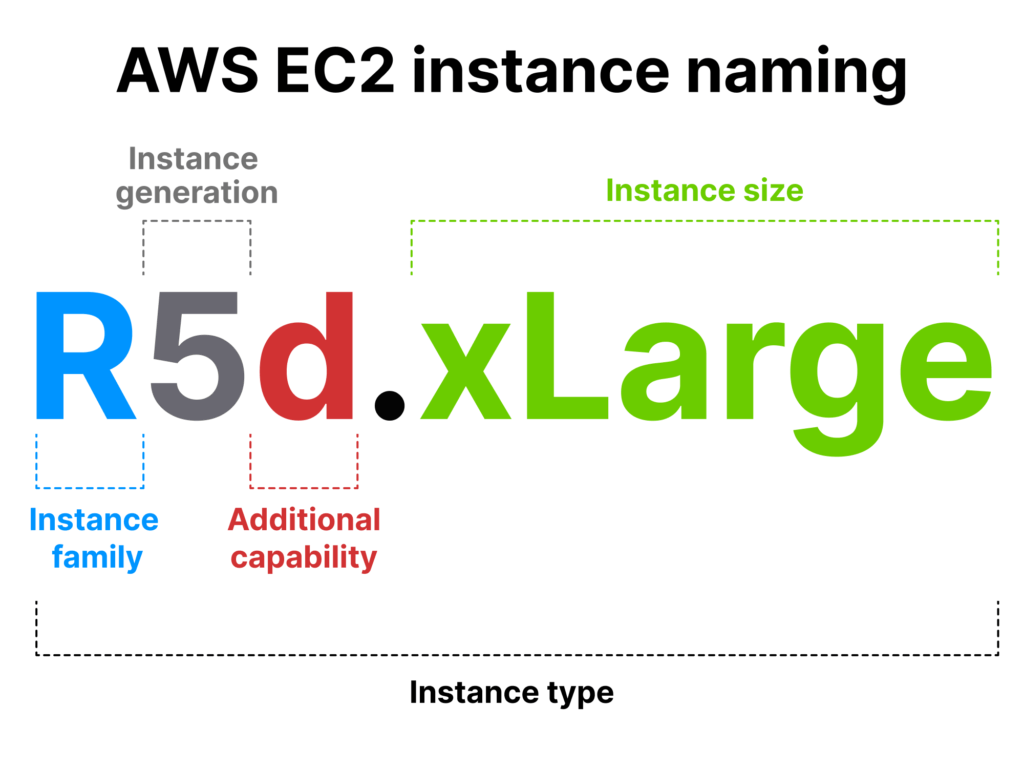
Once you’ve identified the appropriate instance family, the next step is selecting the right instance size. Each EC2 instance family offers a range of sizes, such as nano, micro, small, medium, large, xlarge, 2xlarge and up to 48xlarge.  Each provide varying combinations of CPU, memory, and storage, which doubles memory at each next size: e.g. t3.nano has 0.5 GB of memory, t3.micro – 1 GB, t3.small – 2 GB and so on. The key is to align your workload’s resource demands with an instance size that offers just the right amount of capacity and proper features — no more, no less.

For example, if you’re running a web server with moderate traffic, an m5.large instance might be sufficient. On the other hand, if you’re dealing with high-traffic applications or large-scale data processing, you might opt for an m5.2xlarge or larger instance. Right-sizing your instances ensures you’re not over-provisioning (which leads to wasted costs) or under-provisioning (which can cause performance bottlenecks).

Choosing the correct instance size allows you to optimize both performance and cost, ensuring your applications run smoothly without incurring unnecessary expenses. Regular monitoring and adjustments can help you maintain the right balance as your workload evolves.

Pricing Models and Options for chosen EC2 instance type

AWS offers several pricing models for EC2 instances, allowing users to tailor their cloud costs to their specific needs. The On-Demand pricing model provides the most flexibility, enabling users to pay for compute capacity by the hour or second without long-term commitments. This model is ideal for unpredictable workloads or short-term projects, as it allows for easy scaling up or down. However, it tends to be the most expensive option for long-term use.

Reserved Instances offer a significant discount compared to On-Demand pricing in exchange for a commitment to a specific instance type in a particular region for a one- or three-year term. This model is beneficial for stable workloads with predictable resource requirements, providing cost savings for long-term projects. On the downside, it lacks the flexibility to change instance types or regions without additional charges.

Spot Instances allow users to bid on unused EC2 capacity at potentially lower prices, making them a cost-effective option for flexible, fault-tolerant workloads. However, Spot Instances can be interrupted with little notice, so they are best suited for applications that can handle such interruptions, like batch processing or stateless web servers.

Lastly, Savings Plans provide a flexible pricing model offering lower prices on EC2 and other AWS services in exchange for a commitment to a consistent amount of usage over a one- or three-year term. Unlike Reserved Instances, Savings Plans are more flexible, allowing users to switch between instance families, sizes, and regions.

Choosing the best pricing model depends on your workload patterns and budget. For consistent, long-term workloads, Reserved Instances or Savings Plans can offer substantial savings. For short-term or unpredictable workloads, On-Demand instances provide the necessary flexibility. Spot Instances are perfect for cost-conscious users with workloads that can tolerate interruptions. Balancing these options based on your specific requirements will help you optimize costs while maintaining the performance and reliability of your applications.

Tools and Techniques for Cost Optimization

AWS provides a suite of tools designed to help users manage and optimize their cloud costs effectively. One of the key tools is AWS Cost Explorer, which offers a detailed view of your AWS spending. It enables users to analyze costs and usage patterns over time, identify trends, and forecast future expenses. With its customizable reports, you can drill down into specific services or cost categories, helping you understand where your money is going and identify opportunities for savings.

Another valuable tool is AWS Trusted Advisor, which provides real-time guidance to help you optimize your AWS environment. It offers recommendations across several categories, including cost optimization, security, and performance. For cost management, Trusted Advisor can suggest rightsizing instances, deleting unused resources, and taking advantage of more cost-effective pricing models like Reserved Instances or Savings Plans.

AWS Compute Optimizer is specifically focused on analyzing your Amazon EC2 instances and recommending the optimal instance types based on your actual usage. It assesses various factors, such as CPU, memory, and network utilization, to suggest downsizing, upgrading, or switching to a different instance family. This tool can help ensure that you are not over-provisioning resources, thereby reducing unnecessary costs.

To maximize the benefits of these tools, it’s crucial to regularly monitor your AWS environment and adjust instance usage as needed. Set up alerts for cost anomalies, review usage reports frequently, and take action on optimization recommendations. By staying proactive and leveraging these AWS tools, you can maintain an efficient, cost-effective cloud infrastructure that aligns with your business needs.

Best Practices for Cost Optimization

Achieving cost efficiency in AWS requires a strategic approach to managing resources. One fundamental strategy is right-sizing instances, which involves selecting the optimal instance size that meets your workload’s requirements without over-provisioning. By analyzing your applications’ performance metrics, such as CPU and memory utilization, you can identify underutilized instances and downsize them to more cost-effective options. This not only reduces costs but also ensures resources are used efficiently.

Implementing auto-scaling is another key practice that helps match resource allocation with demand. AWS Auto Scaling automatically adjusts the number of instances in response to real-time changes in workload, scaling out during peak times and scaling in during periods of low demand. This dynamic adjustment ensures that you only pay for the resources you need, optimizing costs while maintaining performance.

For workloads that can tolerate interruptions, leveraging spot instances is an excellent way to reduce expenses. Spot instances allow you to bid on spare AWS capacity at a lower cost, making them ideal for non-critical tasks like batch processing or data analysis. By using spot instances in conjunction with other instance types, you can balance cost savings with availability and reliability.

Finally, it’s crucial to regularly review and adjust Reserved Instances and Savings Plans. As your business needs evolve, so do your AWS usage patterns. Periodically assess your reserved capacity commitments to ensure they still align with your current and future requirements. If necessary, modify or exchange Reserved Instances and Savings Plans to better match your usage, thereby maximizing your savings.

By implementing these best practices, you can optimize your AWS costs effectively, ensuring that your cloud spending aligns with your budget and business goals.

In the ever-evolving landscape of cloud computing, selecting the right EC2 instance types is crucial for optimizing costs and ensuring efficient resource utilization. The variety of AWS instance types and pricing models offers businesses the flexibility to tailor their infrastructure to specific workload needs, balancing performance and cost. By understanding the characteristics and use cases of different EC2 instance families, you can make informed decisions that align with your operational requirements and financial goals.

However, cost optimization is not a one-time task. It requires continuous monitoring and adjustment to adapt to changing workloads and business needs. Regularly reviewing your instance usage, leveraging AWS cost management tools, and adjusting your strategies, such as right-sizing instances or utilizing spot instances, are essential practices for maintaining cost efficiency. By staying proactive and attentive to your AWS environment, you can maximize the value of your cloud investment and support the sustainable growth of your business.

Comprehensive Guide: AWS Savings Plan vs Reserved Instances

As businesses increasingly rely on Amazon Web Services for their cloud computing needs, effective cost management becomes crucial. AWS offers multiple ways to optimize costs, and we have discussed (described, defined, compared) two of them in our previous post: Spot and Reserved Instances. However, there are more options to reduce the cost you spend on your cloud. In this article we will see through the topic of Savings Plans vs Reserved Instances (RIs). This guide provides an in-depth comparison between these two cost-saving strategies, detailing their mechanisms, benefits, and suitability for various workloads. By the end of it, you will be equipped with the knowledge to make a decision on which strategy best aligns with your business needs.

Managing costs in AWS is critical due to the extensive range of services and resources available. Without proper monitoring and optimization, cloud cost can quickly escalate, impacting the bottom line. Implementing an effective cost-saving strategy, such as AWS Savings Plans or Reserved Instances, ensures that businesses can maintain financial control while benefiting from AWS’s powerful offerings.

AWS Savings Plans: Increased Flexibility and Savings

AWS Savings Plans are a cost-effective solution for businesses looking to optimize their cloud spending. These plans provide significant discounts in exchange for a commitment to a consistent amount of AWS usage (measured in $/hour) over a one or three-year term. There are three types of savings plans: Compute Savings Plans, EC2 Instance Savings Plans, and Custom Savings Plans.

1. Compute Savings Plans

Compute Savings Plans are often the most flexible among all AWS Savings Plans. They provide savings of up to 66% on AWS compute usage, covering various services including AWS Lambda, and AWS Fargate. Also, Compute Savings Plan applies to any ECS2 instance, regardless of instance family, AWS region, operating system, or tenancy.

Key Features:

  • Flexibility: Compute Savings Plans allow you to switch between different instance types, regions, operating systems, and tenancies without losing your discount. This is ideal for businesses with dynamic workloads that need to scale resources frequently or migrate applications across different regions.
  • Broad Coverage: The plan’s broad applicability across multiple compute services makes it easier to manage and optimize AWS costs.
  • Ease of Management: With a single commitment, you can enjoy discounts across various AWS services, simplifying cloud cost management.

Ideal For:

  • Organizations with variable and evolving workloads.
  • Businesses looking to modernize their applications with serverless computing or containerized workloads.
  • Companies that require the ability to migrate workloads across different regions and instance types.

2. EC2 Instance Savings Plans

EC2 Instance Savings Plans provide targeted discounts of up to 72% on Amazon EC2 instances within a specific instance family in a chosen region. These plans are slightly less flexible but offer higher discounts compared to Compute Savings Plans.

Key Features:

  • Instance Family Specific: Discounts apply to usage within a specific instance family (e.g., M5, C5) in a particular region. This is suitable for businesses with predictable and steady workloads running on specific instance types.
  • Higher Savings: These plans offer greater discounts due to their more focused nature.
  • Region Specific: EC2 Savings Plans are tied to a specific AWS region, meaning changes to instance types within the same family are allowed, but cross-region usage is not covered.

Ideal For:

  • Organizations with predictable workloads on specific EC2 instance families.
  • Businesses that do not frequently change instance types or regions.
  • Enterprises looking to maximize savings on steady-state applications.

Also, there are Custom Savings Plans, like Amazon SageMaker Savings Plan, which is a tailored solution negotiated with AWS for large-scale customers with unique requirements. These plans offer the most optimized savings based on the customer’s specific usage patterns. These savings plans are applied automatically to your SageMaker instance, no matter what instance family, size, region, or component you use.

Given these points, Savings Plans provide costs reduction by allowing a commitment to a consistent amount of usage over a term. This commitment yields discounts on the usage, regardless of the amount used within the committed level. The flexibility of Compute Savings Plans permits changing instance types or using different AWS services while maintaining cost benefits. EC2 Instance Savings Plans offer savings within a specified instance family and region, suitable for predictable workloads.

savings plan img

AWS Reserved Instances: Maximum Savings for Predictable Workloads

Reserved Instances, as I mentioned before, were the topic, we discussed in our previous article and in case you are in crossroads for the most suitable discount, check out Spot Instances vs Reserved Instances.

Reserved Instances offer significant discounts (up to 75%) over on-demand pricing in exchange for committing to a specific instance type in a particular region for a one or three-year term. There are three types of EC2 Reserved Instances: Standard Reserved Instances, Convertible Reserved Instances, and Scheduled Reserved Instances.

Standard Reserved Instances: These RIs offer the highest discount but the least flexibility. You commit to a specific instance type and can modify attributes like the Availability Zone and instance size within the same family.

Convertible Reserved Instances: These RIs provide lower discounts compared to Standard RIs but allow you to change instance types, operating systems, and tenancy, as long as the new configuration is of equal or greater value.

Scheduled Reserved Instances: These RIs are designed for workloads that need to run at specific times, providing a discount for reserving capacity on a predictable schedule.

Key Benefits of AWS Reserved Instances:

  1. Highest Discounts: Standard RIs offer the largest cost savings for predictable, steady-state workloads.
  2. Customization: Convertible RIs allow for changes in instance types and other attributes, offering a balance between cost savings and flexibility.
  3. Scheduled Usage: Scheduled RIs are perfect for workloads with predictable, time-based usage patterns.

RI illustration

Explore the Differences Between AWS Savings Plans and Reserved Instances

When talking about difference between AWS Savings Plans and Reserved Instances, Compute Savings Plans outperform Reserved Instances in terms of flexibility, as they are applicable across several services and regions. EC2 Instance Savings Plans, while less flexible, are nevertheless useful for predictable workloads. SageMaker Savings Plans automatically apply discounts for organizations focused on machine learning with SageMaker. Standard RIs provide less flexibility but bigger discounts, whereas convertible RIs provide greater flexibility but slightly lower discounts.

Savings Plans usually provide a 66% savings over On-Demand pricing, however Compute Savings Plans offer more flexibility. Reserved Instances offer savings of up to 72 % with Standard RIs and around 54% with Convertible RIs, making them extremely cost-effective for specified workloads.

Savings Plans necessitate a commitment to a consistent hourly usage (USD/hour) over one or three years. Reserved Instances, on the other hand, demand a one- or three-year commitment to specified instance types and geographies, with the option of paying beforehand to maximize discounts. Savings Plans are best suited for dynamic and changeable workloads that demand flexibility, whereas Reserved Instances are excellent for steady-state, predictable workloads with instance type requirements.

Pros and Cons of Each Option

AWS Savings Plans are ideal for organizations needing flexibility and broad service coverage, especially for variable or evolving workloads. However, they require a commitment to a consistent usage amount and can be complex to manage. On the other hand, Reserved Instances provide the highest savings for predictable, steady-state workloads and offer options like Convertible and Scheduled RIs for some flexibility. They require specific instance type commitments and are mainly suitable for EC2 instances, making them less flexible than Savings Plans. By weighing these pros and cons, businesses can choose the best option to optimize their AWS costs based on their unique needs and workload patterns.

Practical Examples and Use Cases

When deciding between wide range of AWS discounts, it’s essential to align your choice with your business needs and usage patterns. For startups and organizations with fluctuating workloads, Compute Savings Plans provide the flexibility needed across various compute services, making them an excellent option. Conversely, large enterprises running steady-state applications can maximize savings with Standard Reserved Instances (RIs), especially if the instance type and region are fixed. These businesses benefit from the substantial discounts provided by Standard RIs.

Modern applications, particularly those leveraging serverless architectures like AWS Lambda, find significant advantages with Compute Savings Plans due to their broad applicability. This makes Compute Savings Plans offer multiple solutions, that are perfect for organizations working in modern, scalable, and efficient serverless environment.

Tools and Resources

AWS provides several tools and resources to assist in the decision-making process. AWS Cost Explorer is a powerful tool that helps visualize and analyze your historical usage and costs, enabling you to identify patterns and predict future needs. AWS Trusted Advisor offers real-time guidance to help you provision your resources according to best practices, optimizing performance, security, and cost efficiency. Utilizing these tools can simplify the assessment process, ensuring you choose the most cost-effective plan aligned with your business objectives.

By carefully evaluating your requirements and utilizing AWS’s comprehensive tools, you can select the right cost-saving strategy – whether an EC2 Instance Savings Plan or Reserved Instance – to optimize your cloud expenditures and drive business growth.

In summary, choosing between AWS Savings Plans and Reserved Instances depends on your business’s needs and usage patterns. AWS Savings Plans offer flexibility and broad applicability, ideal for dynamic workloads. In contrast, Reserved Instances provide significant savings for predictable, steady-state workloads. Leveraging AWS tools like Cost Explorer and Trusted Advisor can help make informed decisions, ensuring you maximize savings while maintaining necessary flexibility and performance. Understanding these differences will empower your business to optimize cloud expenditures effectively and support growth and efficiency in your cloud strategy.

By carefully assessing your business needs, workload patterns, and financial commitments, you can make an informed decision that optimizes your AWS cost management strategy. Taking proactive steps now will ensure that you maximize your investment in AWS while maintaining financial control and operational efficiency.

Comparing AWS EKS vs ECS: An In-Depth Overview

In modern application development, containerization has become an essential tool for managing and deploying applications. AWS offers two major container orchestration services – Amazon Elastic Kubernetes Service (EKS) and Amazon Elastic Container Service (ECS) – that help developers easily deploy, manage, and scale their containerized applications.

Amazon EKS is a managed Kubernetes service that allows developers to run Kubernetes clusters in the AWS cloud without the hassle of managing the underlying infrastructure. It helps developers focus on building and deploying their applications, while AWS takes care of the infrastructure and scaling needs.

Amazon ECS is a highly scalable, high-performance container orchestration service that supports both Docker containers and serverless containers. It offers seamless integration with other AWS services, making it easy for developers to build, deploy, and manage their applications in the cloud.

Understanding Container Orchestration

Container orchestration is the process of managing and automating the deployment, scaling, and management of containers within a cloud computing environment. It involves managing the lifecycle of containers, from creation and deployment to monitoring and scaling, in order to efficiently run and manage applications.

In cloud computing, container orchestration is essential for managing large and complex environments consisting of multiple containers and clusters. It allows organizations to easily deploy and manage applications across multiple servers, making it easier to scale and update applications as needed.

Some common features expected from a container orchestration platform include:

  1. Container deployment and scheduling: This involves the automatic deployment of containers across multiple hosts, as well as the scheduling of tasks to ensure efficient resource utilization.
  2. Scaling and load balancing: Container orchestration platforms have the ability to automatically scale containers based on demand, as well as distribute traffic across multiple containers to ensure optimal performance.
  3. Service discovery: This feature enables containers to communicate with each other, even as they are dynamically created and destroyed.
  4. High availability: Container orchestration platforms ensure high availability of applications by automatically restarting failed containers or moving them to different hosts.
  5. Logging and monitoring: These platforms provide tools for tracking and monitoring the performance of containers, as well as collecting and analyzing logs for troubleshooting and optimization.
  6. Security: Container orchestration platforms have built-in security features, such as authentication and access control, to ensure the security of applications and data within the containers.
  7. Resource management: These platforms allow for the efficient use of resources by automatically reallocating resources from underutilized containers to those with higher demand.

Overview of AWS EKS

EKS is a managed service that allows you to easily deploy, manage, and scale Kubernetes clusters on AWS. It is a fully managed service, meaning that AWS takes care of the underlying infrastructure and maintenance, allowing you to focus on deploying and managing your applications.

Key features of AWS EKS include:

  • Fully managed: As mentioned, AWS EKS is a fully managed service, meaning that AWS takes care of the infrastructure and maintenance, including provisioning and scaling of nodes, handling security updates, and managing the Kubernetes control plane.
  • High availability and scalability: EKS is designed to be highly available and scalable, allowing you to easily add or remove nodes as needed to meet the demands of your applications.
  • Integration with other AWS services: EKS integrates seamlessly with other AWS services, such as Elastic Load Balancing, Amazon VPC, and AWS IAM, making it easy to build and run highly available and secure applications.
  • Support for open-source tools and integrations: EKS supports popular open-source tools and integrations, such as Kubernetes Dashboard, Prometheus, and Fluentd, allowing you to extend and customize your cluster as needed.
  • Automated updates and patches: EKS automatically updates and patches the underlying infrastructure for you, ensuring that your cluster stays up-to-date and secure.Some potential use cases for AWS EKS include:
  • Running microservices architecture: EKS is ideal for running microservices architecture, as it allows you to easily deploy and manage multiple containers and services on a single cluster.
  • High availability and fault tolerance: EKS’s high availability and scalability make it a great choice for applications that require high availability and fault tolerance, such as e-commerce websites and online gaming platforms.
  • Hybrid and multi-cloud environments: EKS can be integrated with on-premises infrastructure and other cloud providers, making it a great choice for companies that have a hybrid or multi-cloud strategy.
  • DevOps and CI/CD: EKS is a great choice for companies that have adopted DevOps practices and use CI/CD pipelines, as it allows for easy deployment and management of containerized applications.

aws eks architecture

Overview of AWS ECS

ECS is a fully managed container orchestration service offered by Amazon Web Services. It allows users to easily run, manage, and scale Docker containers on a cluster of EC2 instances.

Key Features:

  • Easy to use: ECS simplifies the process of running containers by handling the deployment, scaling, and monitoring of containers for you.
  • Scalability: ECS allows you to easily scale your containerized applications up or down based on demand.
  • High availability: ECS automatically distributes containers across multiple Availability Zones to ensure high availability and fault tolerance.
  • Integration with other AWS services: ECS integrates with other AWS services such as Elastic Load Balancing, Auto Scaling, and IAM for a more comprehensive solution.
  • Cost-effective: With ECS, you only pay for the resources you use, making it a cost-effective option for running containers at scale.
  • Flexible deployment options: ECS supports both Fargate (serverless) and EC2 launch types, giving you the flexibility to choose the most suitable deployment option for your application.Benefits:
  • Simplifies container management: ECS automates the deployment, scaling, and management of containers, allowing developers to focus on building and deploying their applications rather than managing the underlying infrastructure.
  • Cost savings: With ECS, you only pay for the resources you use, helping you save costs on infrastructure management.
  • Scalability: ECS makes it easy to scale your containerized applications as your business needs grow.
  • High availability: ECS distributes containers across multiple Availability Zones, ensuring high availability and fault tolerance for your applications.
  • Seamless integration with AWS services: ECS integrates with other AWS services, allowing you to leverage the full capabilities of the AWS ecosystem.
  • Consistent performance: ECS ensures consistent performance for your applications by automatically managing the underlying infrastructure and resources.Use Cases:
  • Microservices: ECS is a great fit for deploying microservices-based applications as it allows for easy scaling and management of individual components.
  • Batch processing: ECS can be used for running batch processing workloads, such as data processing and analytics, in a cost-effective and scalable manner.
  • Web applications: ECS is well-suited for running web applications that require high availability and scalability, such as e-commerce sites or news websites.
  • Dev/Test environments: ECS can be used to quickly spin up development and testing environments, saving time and resources for developers.
  • Hybrid cloud: ECS can be integrated with on-premises infrastructure using AWS Outposts, allowing for a hybrid cloud deployment strategy.

EKS vs. ECS: Key Differences

EKS and ECS allow users to run and manage containerized applications, but they have some key differences in their architecture, management overhead, scalability and flexibility, and integration with other AWS services and third-party tools.

Architecture:

EKS is built on top of Kubernetes, an open-source container orchestration platform. It uses Kubernetes API to manage clusters and runs applications in Docker containers. ECS, on the other hand, is a proprietary service developed by AWS and uses its own API to manage containers. It also supports both Docker containers and Amazon’s own container format, called Amazon Machine Image (AMI).

Management Overhead:

EKS has a higher management overhead compared to ECS. This is because EKS uses Kubernetes, which is a more complex platform and requires more manual configuration and management. EKS also requires users to manage and provision their own underlying infrastructure, such as EC2 instances. On the other hand, ECS is a fully managed service, so AWS takes care of the underlying infrastructure and automates many tasks, reducing the management overhead for users.

Scalability and Flexibility:

Both EKS and ECS are highly scalable and offer flexible deployment options. EKS allows users to scale their clusters up and down based on demand, and also supports horizontal and vertical scaling of containers. ECS also offers auto-scaling capabilities and can scale containers based on metrics such as CPU and memory usage. However, EKS offers more flexibility in terms of deployment options, as it supports both Linux and Windows containers, while ECS only supports Linux containers.

Integration and Compatibility:

Both EKS and ECS integrate well with other AWS services, such as Elastic Load Balancing, IAM, CloudWatch, and more. However, EKS has better compatibility with third-party tools and services, as it uses Kubernetes API, which is a popular and widely-used platform. ECS, being a proprietary service, has limited compatibility with third-party tools and services.

Security Features of EKS and ECS

AWS ECS and EKS offer a variety of security features to ensure the protection of your data and infrastructure.

In many ways, ECS and EKS are equally secure as parts of the AWS cloud platform. However, a significant difference lies in the security tools available. EKS provides access to Kubernetes’ native security features, offering admins and developers more security controls and tools compared to ECS. For instance, admins can utilize Kubernetes audit logs to detect and investigate security incidents, a capability absent in ECS. Both ECS and EKS securely store their Docker container images in ECR (Elastic Container Registry), and each time a container is launched, it retrieves its image securely from ECR.

Pricing Model of EKS vs ECS

The main difference in pricing between the services is that with EKS, you pay $0.10 per hour per running cluster, or $70 for a month of continuous operation. ECS does not have a cost per cluster. This can be significant if you need to run numerous clusters on Amazon.

EKS integrates with AWS Identity and Access Management to provide fine-grained control over who can access your Kubernetes clusters. On the other hand, ECS pricing is based on the resources consumed by your containers, making it a cost-effective option for smaller workloads. EKS pricing includes the cost of the underlying EC2 instances or AWS Fargate resources used to run your containers. EKS is based on the open-source Kubernetes platform, allowing you to leverage the power of Kubernetes without having to manage the underlying infrastructure. Whether you choose ECS or EKS will depend on your specific requirements and budget.

When and which service to choose?

When choosing between Amazon Elastic Kubernetes Service and Amazon Elastic Container Service for container orchestration on AWS, the decision hinges on several factors including management complexity, scalability, flexibility, integration capabilities, and pricing models.

EKS, leveraging Kubernetes, provides a robust and flexible platform suited for organizations that need advanced orchestration features and compatibility with third-party tools. It excels in environments where high customization, multi-cloud capabilities, and extensive automation are essential. However, it comes with a steeper learning curve and requires more hands-on management, potentially leading to higher operational overhead.

ECS, being a fully managed AWS service, offers simplicity and seamless integration with the broader AWS ecosystem. It is ideal for users who prioritize ease of use and quick deployment without the need for extensive infrastructure management. ECS is particularly beneficial for applications that do not require the extensive features of Kubernetes and for teams looking to minimize management overhead.

Both services ensure high performance, reliability, and security, with each having specific strengths. EKS’s flexibility and advanced orchestration features are balanced by ECS’s ease of use and tighter integration with AWS services.

Ultimately, the choice between EKS and ECS should be guided by your organization’s specific requirements, including the complexity of your applications, your team’s expertise, and your strategic goals for cloud deployment. By carefully evaluating these factors, you can select the service that best aligns with your operational needs and enhances your ability to manage and scale containerized applications effectively on AWS.

Understanding AWS EventBridge: A Comprehensive Guide

AWS EventBridge is a powerful event-driven service that allows developers to create highly scalable, event-driven architectures in the cloud. In recent years, event-driven architecture (EDA) has become increasingly popular in the world of cloud computing. This approach to building software systems is based on the concept of events – discrete occurrences that trigger actions or processes within an application.

In an event-driven architecture, different components of an application communicate through events, enabling a more loosely coupled and scalable system. This allows for a more flexible and resilient approach to building applications, as different components can react and respond to events in real-time.

AWS EventBridge is a fully managed event bus service that integrates with a wide range of AWS services and third-party applications. It simplifies the process of building event-driven architectures by providing a centralized event bus, event routing, and event filtering capabilities.

The purpose of this article is to provide a comprehensive understanding of AWS EventBridge. We will explore its key features, use cases, and benefits, as well as how it fits into the larger landscape of event-driven architecture in modern cloud computing. By the end of this article, readers will have a thorough understanding of how to leverage AWS EventBridge to build highly scalable and event-driven applications in the cloud. So, let’s dive in!

What is AWS EventBridge?

Amazon EventBridge is a serverless event bus service provided by Amazon. It allows developers to build event-driven architectures and integrate various AWS services, SaaS applications, and custom applications.

EventBridge is a serverless event bus that processes events from various event sources such as Amazon CloudWatch, Amazon SNS, AWS Lambda, API Gateway, and more. Developers can use EventBridge to route events to specific AWS services like Lambda functions, SQS, and Step Functions.

EventBridge provides a schema registry to define the structure of the event data and content-based event filtering to route events based on their content.

Event-driven Architecture Fundamentals

Event-driven architecture is a powerful design pattern that enables the creation of scalable, real-time data integrations using AWS services. At its core, the architecture revolves around the concept of events, which trigger actions in response to specific occurrences. To implement event-driven architecture using AWS, developers can leverage services such as EventBridge, which serves as a central hub for event ingestion and processing. EventBridge supports custom events, event patterns, and event integration with a variety of AWS applications and services. It is natively integrated with services like AWS Lambda functions, making it easier to build event-driven applications or services.

Additionally, EventBridge simplifies the process of integrating with external sources by providing a scalable event bus that enables seamless communication between different systems. The EventBridge schema registry stores the structure of incoming events, ensuring that data is properly interpreted and processed by downstream applications. By directly integrating with a variety of AWS services and with built-in event sources, EventBridge makes it easy to exchange data in real-time and connect with SAAS applications via event patterns.

aws eventbridge running

How Does AWS EventBridge Work?

Here is a step-by-step explanation of how AWS EventBridge works:

  1. Event Generation: The first step in the EventBridge process is event generation. Events can originate from different sources, such as AWS services, custom applications, or SaaS applications. These events can be triggered by a specific action, such as a new file being uploaded to an Amazon S3 bucket, or they can be scheduled events, such as a daily backup job.
  2. Event Routing: Once an event is generated, it is sent to the EventBridge service. EventBridge acts as a central hub for all events and routes them to their designated targets. This routing is based on rules that are set up by the user. These rules specify which events should be sent to which targets based on certain criteria, such as event type or source.
  3. Event Processing: After an event is routed to its target, it is processed according to the designated action. For example, if the target is an AWS Lambda function, the event will trigger the function to execute a specific code. If the target is an SQS queue, the event will be stored in the queue for later processing.
  4. Event Delivery: Once the event is processed, EventBridge delivers a response to the source of the event. This response can include information about the success or failure of the event processing, which helps to track the status of events and troubleshoot any issues.
  5. EventBridge Features: EventBridge offers several features to help manage events efficiently. These include event filtering, event transformation, and event replay. Event filtering allows users to specify which events should be routed to which targets, while event transformation allows users to modify the event data before it is sent to the target. Event replay allows users to replay past events in case of any failures or missed events.

Core Features of AWS EventBridge

  1. Event-Driven Architecture: AWS EventBridge is designed to support event-driven architecture by allowing you to create event-based workflows and integrations. This means that actions are triggered by events, instead of being scheduled or manually initiated.
  2. Real-Time Event Processing: EventBridge can process events in real-time, allowing you to quickly respond to changes and updates in your environment. This makes it ideal for applications that require real-time data processing, such as streaming analytics and real-time monitoring.
  3. Flexible Event Routing: With EventBridge, you can easily route events to multiple targets, such as AWS Lambda functions, Amazon SNS topics, and Amazon SQS queues. This allows for greater flexibility and scalability in your event-based workflows.
  4. Event Filtering: EventBridge allows you to filter events based on specific criteria, such as event source, event content, and event time. This helps you to manage and process only the events that are relevant to your applications.
  5. Easy Integration: EventBridge integrates seamlessly with other AWS services, as well as third-party applications and services. This makes it easy to incorporate event-based workflows into your existing infrastructure.
  6. Event Replay: With EventBridge, you can replay events from the past 24 hours, making it easy to test and troubleshoot your event-based workflows. This can also be useful for recovering from errors or failures.
  7. Cost-Effective: EventBridge follows a pay-per-event pricing model, which means you only pay for the events that are processed by the service. This makes it a cost-effective solution for event-driven applications.
  8. Easy to Use: EventBridge is easy to set up and use, with a simple interface and intuitive features. This allows developers to quickly create event-based workflows without a steep learning curve.
  9. Monitoring and Logging: EventBridge provides detailed monitoring and logging capabilities, allowing you to track the performance of your event-based workflows and troubleshoot any issues that may arise.

Integration with AWS services

Amazon Web Services (AWS) offers a wide range of cloud computing services that can be integrated with other applications and services. This allows for a more efficient and seamless flow of data between different systems, as well as providing access to powerful tools and features that can enhance the functionality of your application.

Some of the most popular AWS services that can be integrated with other applications include:

  1. Amazon S3 (Simple Storage Service): This service allows for secure and scalable storage of data in the cloud. It can be integrated with applications to store and retrieve data, such as user files, media, and backups.
  2. Amazon EC2 (Elastic Compute Cloud): This service provides virtual servers, known as instances, that can be used to run applications. It can be integrated with other services to provide a scalable and reliable infrastructure for your application.
  3. Amazon RDS (Relational Database Service): This service allows for the creation and management of relational databases in the cloud. It can be integrated with applications to store and retrieve data, such as user profiles, product information, and more.
  4. Amazon API Gateway: This service allows for the creation, management, and deployment of APIs. It can be integrated with applications to enable secure and efficient communication between different systems.
  5. Amazon Lambda: This service allows for the execution of code in response to events or triggers. It can be integrated with applications to automate tasks and processes, such as data processing or sending notifications.
  6. Amazon CloudWatch: This service provides monitoring and logging capabilities for your AWS resources. It can be integrated with applications to track and analyze performance metrics, as well as set up alerts and notifications.
  7. Amazon SES (Simple Email Service): This service allows for the sending and receiving of email messages. It can be integrated with applications to send transactional or marketing emails to customers.
  8. Amazon SNS (Simple Notification Service): This service allows for the sending and receiving of push notifications to mobile devices. It can be integrated with applications to send real-time updates and notifications to users.

Schema registry and discovery

Schema registry and discovery are two crucial components in the world of data management and integration. The schema registry serves as a centralized repository for storing and managing data schemas, ensuring consistency and compatibility across systems. On the other hand, discovery enables the automatic detection and sharing of data schemas, making it easier for applications to communicate with each other. Together, these two tools play a vital role in simplifying data integration and promoting data interoperability in complex environments.

Implementing AWS EventBridge

  • Create an EventBridge rule: To create an EventBridge rule, go to the AWS EventBridge console and click on the “Create rule” button. Give your rule a name and description, and then choose the event source. This can be an AWS service, a custom event bus, or an external event source. You can also choose to filter events based on specific criteria.
  • Configure targets: Next, you will need to configure the targets for your rule. These are the actions that will be performed when an event is received by the rule. You can choose from a variety of targets, such as Lambda functions, SNS topics, or Step Functions.
  • Set permissions: To allow your rule to send events to the chosen targets, you will need to set permissions. This can be done by creating a new IAM role or using an existing one.
  • Test your rule: Once your rule is created and configured, you can test it by sending test events to it. This will allow you to see if your rule is triggering the desired actions.
  • Monitor your rule: You can monitor the execution of your rule and the events it receives by going to the EventBridge console and viewing the rule’s dashboard. This will show you the number of events received, any errors, and the status of the targets.
  • Manage and update your rule: You can manage and update your rule as needed by going to the EventBridge console and selecting your rule. From here, you can edit the rule, add or remove targets, and change the event source or filtering criteria.
  • Automate with CloudFormation: To easily deploy and manage multiple EventBridge rules, you can use AWS CloudFormation. This allows you to define your rules in a template and easily deploy them to different environments.
  • Use EventBridge with other AWS services: EventBridge can be integrated with other AWS services, such as AWS Lambda, Amazon SNS, Amazon SQS, and more. This allows for more complex and automated event-driven workflows.

Best Practices for Using AWS EventBridge

  1. Design Considerations for Event-Driven Architectures – іdentify the events and triggers. Start by defining the events that your system needs to respond to and identify the triggers that will initiate those events. This will help in designing a clear and efficient event-driven architecture.Choose the right event source: AWS EventBridge supports various event sources such as AWS services, custom applications, and SaaS providers. Choose the event source that best fits your use case.Design for scalability and fault tolerance: As your system grows, the number of events and triggers will increase. Design your architecture to handle this growth and ensure that it is fault-tolerant to handle any failures.Use event schemas: EventBridge allows you to define event schemas that can be used to validate the incoming events. Use schemas to ensure that the events are in the expected format and avoid processing invalid events.Consider event delivery guarantees: EventBridge offers two delivery guarantees – at least once and exactly once. Choose the delivery guarantee based on the criticality of your events and the impact of duplicate events.
  2. Security and Permissions – use IAM roles and policies. EventBridge integrates with AWS Identity and Access Management (IAM) to control access to resources. Use IAM roles and policies to grant permissions to users and services that need to access EventBridge.Enable encryption: Enable server-side encryption for your event bus to ensure that your events are always encrypted at rest.Use AWS KMS: Use AWS Key Management Service (KMS) to manage the encryption keys used by EventBridge. This ensures that you have full control over the encryption keys and can manage them centrally.Use resource policies: EventBridge supports resource policies that allow you to control access to your event buses at a more granular level. Use resource policies to restrict access to specific event buses to specific IAM users or roles.
  3. Monitoring and Troubleshooting Tips – use CloudWatch Metrics. EventBridge automatically publishes metrics to CloudWatch, which can be used to monitor the health of your event buses and rule executions. Use these metrics to set up alarms and get notified of any issues.Enable CloudTrail: CloudTrail records API calls made to EventBridge, which can be useful for troubleshooting and auditing purposes. Enable CloudTrail and review the logs in case of any issues.Use CloudWatch Logs: EventBridge allows you to log events to CloudWatch Logs, which can help in troubleshooting and debugging your event-driven architecture. Use CloudWatch Logs to view the details of incoming events and troubleshoot any errors.Use Amazon EventBridge Console: The Amazon EventBridge console provides a visual representation of your event buses, rules, and targets. Use the console to monitor the flow of events and troubleshoot any issues with your event-driven architecture.

Comparing AWS EventBridge with Alternatives

There are a few alternatives to AWS EventBridge, and here we will compare it with some of the popular options:

  1. AWS Simple Queue Service (SQS): AWS SQS is a managed message queue service that allows decoupling of components in a distributed system. It is a reliable and highly available service that can handle large volumes of messages. Unlike EventBridge, SQS does not have built-in event routing and transformation capabilities. Users have to handle these functionalities themselves by using other AWS services like AWS Lambda or Amazon Simple Notification Service (SNS). This can require additional development effort and may not be suitable for complex event-driven architectures.
  2. Apache Kafka: Apache Kafka is an open-source distributed event streaming platform. It is highly scalable and can handle large volumes of events. Kafka provides features such as event routing and transformation through its Streams API. However, setting up and managing Kafka clusters can be complex and requires a significant amount of resources. It may not be suitable for smaller applications or those without dedicated DevOps resources.
  3. Google Cloud Pub/Sub: Google Cloud Pub/Sub is a fully managed event streaming service provided by Google Cloud Platform. It offers similar capabilities to AWS EventBridge, such as event routing and transformation. However, it is limited to Google Cloud services and does not have integrations with third-party applications. This can be a drawback for users who need to connect their custom applications or services from other cloud providers.
  4. Azure Event Grid: Azure Event Grid is a serverless event routing service offered by Microsoft Azure. Like AWS EventBridge, it supports event filtering, routing, and transformation. However, it is limited to Azure services and does not have integrations with third-party applications. It also has a lower event processing limit compared to AWS EventBridge. This can be a limitation for applications that require high event processing volumes.

Real-world Use Cases

  • Automated Workflows and Process Automation: AWS EventBridge can be used to create automated workflows and processes, helping organizations to streamline their operations and reduce manual work. For example, an e-commerce company can use EventBridge to trigger a series of events when a customer places an order, such as sending a confirmation email, updating inventory, and initiating the shipping process.
  • Serverless Architecture and Microservices: EventBridge is a key component in building serverless architectures and microservices on AWS. It allows different services and applications to communicate with each other through events, reducing the need for complex integrations and point-to-point connections. This enables organizations to build scalable and flexible systems that can handle large volumes of data and events.
  • Data Ingestion and Processing: EventBridge can be used for real-time data ingestion and processing, making it an ideal solution for streaming data from various sources. For example, a media company can use EventBridge to ingest and process user interaction data from their website, social media, and mobile apps in real-time, allowing them to make data-driven decisions and personalize user experiences.
  • Monitoring and Alerting: EventBridge can be used for monitoring and alerting in cloud environments. It can receive events from different AWS services, such as Amazon CloudWatch, and trigger actions or send alerts based on predefined rules. This allows organizations to proactively monitor their resources and respond to any issues or anomalies in real-time.
  • DevOps and CI/CD Pipelines: EventBridge can be integrated with DevOps tools and services to automate the deployment and management of applications. It can receive events from source code repositories, build and test systems, and deployment tools, triggering actions and updates as needed. This enables organizations to build efficient and reliable CI/CD pipelines for their software development processes.
  • Cloud Infrastructure Management: EventBridge can be used to manage and automate cloud infrastructure, such as launching and terminating instances, scaling resources, and managing backups. This helps organizations to optimize their cloud resources and reduce costs by automatically scaling up or down based on demand.
  • IoT Applications: EventBridge can be used for building event-driven IoT applications. It can receive events from IoT sensors and devices, triggering actions and updates in real-time. For example, a smart home system can use EventBridge to control and automate devices based on events, such as turning on lights when a person enters a room.
  • Data Analytics and Machine Learning: EventBridge can be integrated with AWS services for data analytics and machine learning, such as Amazon Kinesis and Amazon SageMaker. This allows organizations to capture and process events in real-time and use the data for training machine learning models and making data-driven decisions.
  • Chatbots and Voice Assistants: EventBridge can be used to build chatbots and voice assistants that can respond to user requests and trigger actions based on events. For example, a customer service chatbot can use EventBridge to access customer information and provide personalized responses based on events, such as a customer placing an order or requesting a refund.
  • Third-Party Integrations: EventBridge can be used to integrate with third-party services and applications, such as CRM systems, marketing automation tools, and payment gateways. This enables organizations to automate workflows and processes across different systems, improving efficiency and reducing manual work.

Summary

AWS EventBridge stands out as a versatile and robust service designed to facilitate the creation and management of event-driven architectures in the cloud. By providing a centralized event bus with seamless integration capabilities, it enables developers to connect various AWS services, third-party applications, and custom applications through events. This fosters the development of scalable, resilient, and real-time responsive systems.

EventBridge’s core features—such as flexible event routing, real-time event processing, and event filtering—make it an essential tool for building efficient and dynamic workflows. Its integration with AWS services like Lambda, S3, and CloudWatch further enhances its utility, simplifying complex event-driven processes. The service’s cost-effectiveness, ease of use, and support for multi-cloud environments ensure that organizations can leverage it without significant overhead.

Moreover, AWS EventBridge’s schema registry and discovery capabilities promote data consistency and interoperability, which are crucial for complex data integration tasks. The ability to automate processes, manage cloud infrastructure, and build serverless architectures underscores EventBridge’s role in modern cloud computing.

When comparing EventBridge to alternatives like AWS SQS, Apache Kafka, Google Cloud Pub/Sub, and Azure Event Grid, its seamless AWS ecosystem integration, coupled with extensive features for event routing and processing, offers a distinct advantage. This makes EventBridge particularly appealing for organizations already invested in AWS or seeking a fully managed event bus service.

In real-world scenarios, EventBridge proves invaluable across various domains, including automated workflows, data ingestion and processing, DevOps, IoT applications, and more. Its ability to trigger actions based on events enables businesses to streamline operations, enhance real-time data handling, and build responsive systems.

Overall, AWS EventBridge is a critical component for developers aiming to implement event-driven architectures in the cloud. Its comprehensive feature set, ease of integration, and support for diverse use cases make it a powerful tool for building scalable, flexible, and efficient cloud-native applications.