Schedule MongoDB Atlas M20 Clusters and Cut ~70% of Compute Spend (When You Use < 50 Hours/Week)

MongoDB Atlas doesn’t have options like AWS with Savings Plans or Reserved Instances. Atlas offers its own subscription credits instead. That makes scheduling the biggest lever for non‑prod clusters. With CloudAvocado you can schedule MongoDB clusters and drop compute costs by ~70% when clusters are used < 50 hours per week.

Why schedule Atlas now?

  • On‑demand compute adds up: An M20 is $0.20/hour (about $146.72/month if you
    run 24×7; region may vary). MongoDB
  • No similar to AWS SPs/RIs to lower the bill
  • Atlas has its own commits: You can buy Atlas subscription credits (monthly/annual). That’s not the same as AWS Savings Plans/RIs. MongoDB
  • Most dev/test clusters run < 50 hours/week: Matching runtime to working hours eliminates the majority of compute spend.

What Atlas supports natively (and the limits)

Atlas Pause/Resume (UI, CLI, or Admin API) works for M10+ clusters that do not use NVMe, for up to 30 days, and you must let a cluster run 60 minutes after resuming before pausing again. While paused, Atlas charges only for storage(compute and data transfer stop). Flex and Serverless cannot be paused. MongoDB
Why teams still struggle with DIY: You end up wiring cron/Lambda, tracking 30‑day auto‑resume, honoring the 60‑minute run rule, rotating API keys, and remembering which projects/regions are eligible.

How CloudAvocado handles Atlas scheduling

    • Connect Atlas with a scoped API key.
    • Discover clusters across projects/regions (Atlas) alongside your AWS resources in one dashboard.
    • Pick a schedule (e.g., Weekdays 09:00–19:00)
    • Apply by tag or bulk‑select; new clusters inherit the schedule automatically.

Under the hood, CloudAvocado calls the Atlas Admin API for you, re‑pauses clusters after Atlas’ 30‑day auto‑resume.

The math for an M20 used < 50 hours/week

Pattern Hours / month Cost @ $0.20/hr Savings vs 24×7
24×7 (baseline) 720 $144.00
Weekdays always‑on (24h × 5d) ~520 $104.00 28%
Business hours (10h × 5d ≈ 50h/week) ~217 $43.40 ~70%

Notes: Uses 50 h/week × ~4.33 weeks/month ≈ 216–217 h. Storage continues to bill while paused; compute and data transfer do not. MongoDB
Scale that across three M20 dev clusters and you’re saving ~$300/month on compute before any rightsizing.

Gotchas (and how CloudAvocado avoids them)

  • Eligibility: CloudAvocado flags clusters that can’t pause (Flex, Serverless, NVMe, some multi‑region setups). MongoDB
  • 30‑day auto‑resume: It re‑pauses if your schedule still applies. MongoDB
  • 60‑minute cool‑down: It waits the required hour after resume before pausing again. MongoDB
  • Warm‑up time: Search indexes/backups can trigger work after resume, consider that time. MongoDB
  • Commit vs. schedule: If you buy Atlas subscription credits, scheduling prevents you from burning them on idle hours but it won’t retroactively reduce a commitment. MongoDB

Next steps

  • Start a free CloudAvocado trial, connect your Atlas project and AWS accounts, and watch tomorrow’s dashboard reflect real savings.
  • Share this guide with your DBA + FinOps teams; standardize on < 50 hours/week for non‑prod as your default policyi

Need a simple AWS cost optimization solution?

Schedule a free demo with a cloud cost optimization expert

Schedule a demo

How to Schedule AWS EC2 Instances in 5 Minutes (and Save 70% on Your Bill)

Amazon EC2’s pricing means you’re billed for every second an instance is running – even if it’s sitting idle. Most development, testing environments don’t need 24/7 compute even though companies often leave these instances running constantly. This idle time translates to extra cloud spend. If your instances are only used ~10 hours a day on weekdays (50 hours/week), you could save around 70% by shutting them down after hours. Usually dev teams isn’t working 24/7, but dev environments never stops. I want to share options how to schedule AWS EC2, RDS, ECS, EKS.

Why AWS Resource Scheduling Matters More Than Ever

As I mentioned above – most companies use their AWS instances run 24/7. The math is simple but painful: if your team works 40 hours per week, you’re paying for 128 hours of unused compute time.

Here’s what I typically see when auditing AWS accounts:

  • Development environments running 24/7 with no need
  • Test instances that haven’t been accessed in weeks but still running
  • Many test instances was used for a couple days and abandoned after that for weeks

The solution isn’t complex – it’s about aligning resource availability with actual need through scheduling.

Real Cost Impact: AWS Scheduling Examples

Lets look on sample dev environment with numbers:

Scheduling Strategy Instance Type Usage Pattern Monthly Cost Savings vs 24/7
Always On (Baseline) 10 × m6i.xlarge 720 hrs/month $1,382.40
Weekend Shutdown 10 × m6i.xlarge Weekdays 24/7 $921.60 33% ($460.80)
Business Hours 10 × m6i.xlarge 10hrs × 5 days $384.00 72% ($998.40)

*Based on $0.192/hour per m6i.xlarge instance in us-east-1

Traditional Ways to Schedule EC2 (and Their Drawbacks)

Before introducing CloudAvocado solution, it’s worth noting how teams often handle EC2 scheduling using native AWS or DIY methods:

AWS Instance Scheduler: AWS provides a solution (now via Systems Manager Resource Scheduler) to start/stop instances on a schedule You define cron-like schedules and tag instances to follow them.

  • Pros:

    • Effective;  works across multiple account in organization
    • works across multiple account in organization
  • Cons:

    • require non-trivial setup
    • someone need to maintain it
    • limited list of supported services

Custom Scripts or Lambda Functions: Some teams write their own AWS Lambda functions triggered by CloudWatch Events (cron expressions) to stop and start instances.

  • Pros:

    • Effective
    • Gives more flexibility (and can even implement logic like “stop if CPU < 5% for 1 hour”)
  • Cons:

    • someone need to write code and maintain it, ensure that script runs in all target accounts/region

Manual Effort: The simplest (but least scalable) method is manually stopping instances via the AWS Console or CLI. I used this method long time ago.

  • Pros:

    • Effective
    • Free to use
  • Cons:

    • it’s easy to forget about it

Why look for an alternative? These methods either require engineering time to set up and maintain (infrastructure-as-code, scripting) or they rely on humans to click buttons. This is where CloudAvocado comes in – offering a user-friendly UI to automate instance scheduling without any custom scripts<span”>, in a matter of minutes.

Scheduling EC2 Instances in 5 Minutes with CloudAvocado

CloudAvocado is a cloud cost optimization tool focused on AWS. One of its core features is automated scheduling of resources like EC2 (and RDS, etc.) to eliminate paying for idle time. We’ll see how to get started quickly and implement a smart schedule. No deep AWS expertise or coding required – perfect for DevOps engineers who want results fast.

1. Onboard Your AWS Account (No Scripts Needed)

To use CloudAvocado, you first connect it to your AWS environment. The good news: this setup is extremely simple and doesn’t involve running any scripts or agents on your side. CloudAvocado uses a secure cross-account role approach:

  • Sign Up & Connect: Sign up for a CloudAvocado account (a free trial is available). In the onboarding, you’ll be guided to create an AWS IAM Role with a predefined policy that grants CloudAvocado the minimal permissions it needs (like reading EC2 info and toggling start/stop). There’s no manual scripting – just follow the step-by-step instructions either with CloudFormation script or manual.

CloudAvocado immediately discovers your instances (and other resources, like ECS, EKS, RDS, etc.) in that account.

CloudAvocado’s platform is built for multi-account aggregation – you can easily view and schedule instances across dev, staging, and prod accounts all in one place. No more juggling AWS logins or switching regions manually.

2. Visualize Utilization with the Dashboard & Heatmaps

Once connected, CloudAvocado gives you a unified dashboard of your cloud usage and costs. Instead of combing through AWS Cost Explorer or CloudWatch metrics, you get a clear visual overview:

CloudAvocado’s dashboard provides a visual summary of your AWS costs and usage. Imagine merging CostExplorer and CloudWatch The intuitive UI includes charts (even heatmaps) highlighting usage patterns and potential waste. This makes it easy to identify idle periods at a glance.

  • Utilization Heatmaps: CloudAvocado includes visualizations that correlate when your instances are running (and how much they’re utilized). For example, you might see a weekly heatmap showing hours of high vs. low CPU utilization across your instances. These visuals quickly highlight that, say, CPU usage drops to near-zero every day after 7 PM – a strong indicator that the instance could be shut off at that time. By spotting dark “cold” areas on the heatmap (periods of low utilization), you identify scheduling opportunities immediately.
  • Metrics & Recommendations: The platform also presents charts of CPU and memory usage down to an hourly granularity, along with cost analytics. It can even highlight underutilized resources and suggest where you could save This approach helps build confidence that turning off an instance won’t disrupt anyone – you can literally see that it’s idle out-of-hours before you schedule it off.

Overall, with overwhelming amount of data from CloudWatch and CostExplorer – the UI is designed to remove as much noice as possible.

3. Define a Schedule (Idle-Aware Stop Times)

Now comes the core task: creating a schedule that will automatically stop and start your EC2 instances according to your desired timings. In CloudAvocado, this is done through a simple Schedules UI (no cron syntax needed):

  • Choose Off-Hours: Define the days and time ranges when instances should run, and when they should be shut down. For example, you might create a schedule named “Weekdays-9to5” that starts instances at 9:00 AM and stops them at 7:00 PM, Monday through Friday. You can specify time zone as needed. This covers turning them off on weeknights and all weekend.
  • Metric based schedule: A schedule Instead of a blunt stop at exactly 7:00 PM, you can configure an idle timeout after working hours– e.g. “stop if the instance has been idle for 60 minutes after 7:00 PM.”  People tent to work a bit shifted time, especially with remote work. This means if someone is using the instance past 7, the instance won’t be terminated mid-task. It will wait until the CPU drops below a threshold (set per instance, “Idle” is different for different resources) for set duration before shutting down.

This smart scheduling ensures you capture maximum savings without hurting productivity. You avoid the scenario of forgetting to turn off instances (wasting money), and avoid the risk of turning something off while it’s still needed. Everything is configurable in a few clicks.

4. Apply Schedules to Instances (or Automate with Tags)

After defining a schedule, you need to assign it to the target instances:

  • Direct Assignment: In the CloudAvocado Resources view, you can bulk-select the EC2 instances you want to schedule and simply apply your new schedule to them. For example, you might select all instances in the “Dev” environment group and apply the “Weekdays-9to7” schedule in one go. The UI clearly shows which resources have which schedule active.
  • Tag-Based Scheduling: For more convenient automation, CloudAvocado has custom AWS resource. Just assign CloudAvocado schedule tag to resources, with schedule id. This way, whenever a new instance with that tag appears, it will automatically inherit the appropriate schedule.
  • Multi-Account, Multi-Region: All of this works across multiple AWS accounts and regions seamlessly. If you’re a cloud engineer managing workloads for several teams or clients, you can view all their instances in CloudAvocado and apply schedules without having to log into each account separately. This aggregated view and control is a huge time-saver and prevents oversight.

Once a schedule is applied, CloudAvocado’s automation takes over. There’s no need to visit the AWS Console to start or stop instances manually – or to check if the schedule ran. You can always see the current state (running or stopped). And if you ever need to override (e.g. keep an instance running late just one night), you can disable schedule for “X amount of hours”

*  Create Teams and add Users (Optional)

CloudAvocado has role based access control, you can define different roles, assign resources to teams, etc.

Conclusion: Save Costs in Minutes – Give It a Try

Scheduling AWS resources is one of those quick wins in cloud cost optimization: it’s relatively easy to implement and brings significant savings (often on the order of 60–70% for non-prod environments). By using CloudAvocado, you can setup this process in couple minutes – without writing code or managing schedules by hand. As well – consider that it’s not just about EC2, CloudAvocado also supports ECS, EKS, RDS, DocumentDB, SageMaker.  

Need a simple AWS cost optimization solution?

Schedule a free demo with a cloud cost optimization expert Schedule a demo

Cloud Cost Management Simplified: FinOps Best Practices

FinOps best practices are essential for organizations aiming to manage cloud expenses effectively while maximizing business value. As cloud adoption grows, businesses face increasing challenges in optimizing costs without compromising performance. Without a structured approach, cloud spending can escalate, leading to inefficiencies and budget overruns.

This is where FinOps (Financial Operations) plays a critical role. It is a collaborative discipline that integrates finance, engineering, and business teams to ensure financial accountability and optimize cloud investments. FinOps enables organizations to shift from reactive cost-cutting to proactive cost optimization, aligning cloud usage with business goals.

In this article, we’ll explore FinOps best practices, focusing on actionable insights that help businesses control cloud costs while maintaining agility. Whether your infrastructure runs on AWS, Azure, or Google Cloud, applying FinOps principles helps pinpoint wasteful spending, optimize resource allocation, and enforce financial accountability.

What is FinOps?

FinOps (Financial Operations) is a cloud financial management approach that helps businesses achieve cost efficiency while maintaining performance and scalability. Unlike traditional IT budgeting, FinOps embraces the dynamic, usage-based cost model of cloud computing, ensuring that costs are tracked, optimized, and aligned with business objectives.

Core Principles of FinOps

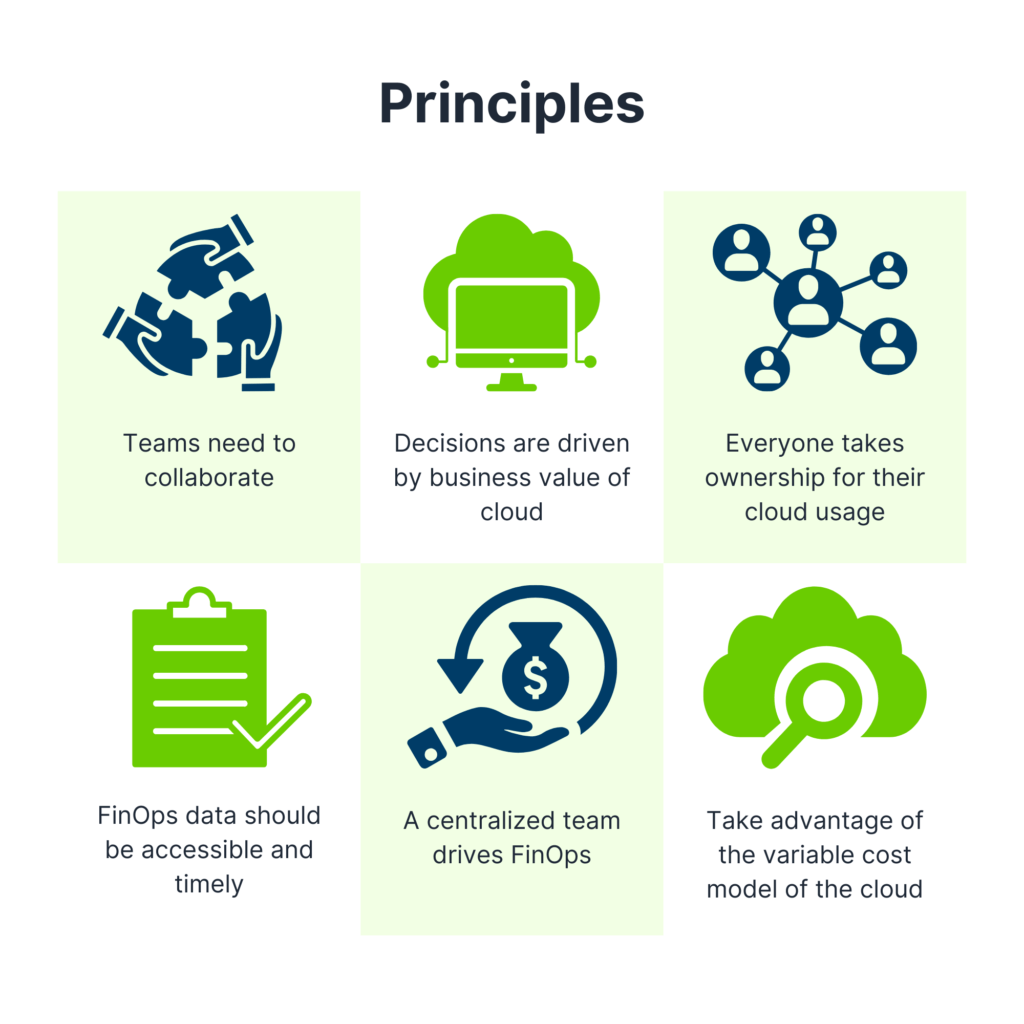
Successful FinOps practices are built on six key principles that help organizations manage cloud costs effectively:

Teams Need to Collaborate – Cloud cost management is a shared responsibility across finance, engineering, and business teams. Cross-functional collaboration ensures that spending decisions balance cost and performance.

Decisions Are Driven by Business Value – Cloud investments should be justified by measurable business impact, not just cost-cutting.

Everyone Takes Ownership of Their Cloud Usage – Engineers, finance, and operations teams are accountable for their cloud consumption and optimizations.

FinOps Reports Should Be Accessible and Timely – Real-time cost visibility enables proactive decision-making rather than reacting to monthly invoices.

A Centralized Team Drives FinOps Best Practices – While all teams contribute to cost management, a dedicated FinOps function ensures governance and policy enforcement.

Take Advantage of the Cloud’s Variable Cost Model – Cloud pricing is dynamic, and FinOps promotes autoscaling, reserved instances, and commitment-based discounts to optimize costs.

By applying these principles, organizations can transition from uncontrolled cloud expenses to a data-driven, optimized cost management strategy.

finops principles

Key FinOps Best Practices for Cloud Cost Management

FinOps best practices are structured within FinOps capabilities, and categorized into key domains ensuring an efficient and measurable approach to cloud cost management. Rather than listing every capability, we’ll highlight the most impactful practices that deliver immediate value.

Build a FinOps Culture Across Teams

One of the foundational FinOps best practices is fostering a culture of collaboration where finance, IT, and business teams work together. Managing cloud costs requires more than just financial oversight – it involves cross-functional alignment to ensure cost efficiency without sacrificing performance.

Foster Collaboration Between Finance, IT, and Business Units

  • Finance teams gain real-time visibility into cloud spending, improving budgeting accuracy.
  • IT and engineering teams get actionable insights to optimize workloads and prevent unnecessary spending.
  • Business leaders ensure that cloud investments align with strategic objectives and revenue goals.

FinOps encourages ongoing collaboration, making cost management an integrated, continuous practice rather than an afterthought.

Define Clear Roles and Responsibilities

A well-structured FinOps practice includes clearly defined roles:

  • FinOps Lead – Oversees financial governance and ensures strategy alignment.
  • Cloud Engineers & DevOps – Optimize resources, eliminate waste, and implement automation.
  • Finance & Procurement – Monitor budgets, forecast spending, and set financial controls.
  • Executives & Business Leaders – Set cost efficiency goals and oversee high-level cloud spending decisions.

Establishing these roles ensures that FinOps implementation remains a continuous, company-wide effort.

Set Budgets and alerts

A core aspect of FinOps cost management is defining budgets and cost allocation strategies to prevent unexpected expenses. Organizations should proactively allocate spending limits and monitor them in real time.

  • Define cost limits for teams, projects, and workloads.
  • Use cloud provider tools like AWS Budgets, Azure Cost Management, and Google Cloud Billing for tracking.
  • Enable real-time alerts for spending anomalies or unexpected cost spikes.
  • Regularly review and adjust budgets based on cloud usage trends.

Budgeting within FinOps ensures cloud costs remain predictable, preventing budget overruns and inefficient spending.

Optimize Resource Usage

Many organizations over-provision cloud resources, leading to unnecessary expenses. FinOps emphasizes continuous optimization by rightsizing infrastructure and eliminating inefficiencies.

Rightsize Instances and Storage

  • Analyze usage metrics to detect underutilized compute, memory, and storage.
  • Scale down oversized instances or migrate workloads to more cost-effective options.
  • Use tiered storage solutions (e.g., S3 Glacier, Azure Cool Storage) for infrequently accessed data.

Use Reserved Instances and Autoscaling Effectively

  • Rate Optimization & Licensing – Leverage Reserved Instances (RIs) and Savings Plans for predictable workloads.
  • Autoscaling & Spot Instances – Use spot pricing for non-critical workloads to reduce costs.

Automate Cost Optimization

Automating cost management reduces manual effort while ensuring continuous optimization.

  • Idle Resource Detection – Tools like AWS Trusted Advisor and Google Cloud Recommender help identify unused resources.
  • Scheduled Shutdowns – Automate turning off non-production workloads during off-hours.
  • Automated Data Lifecycle Management – Implement backup automation and storage tiering to optimize storage costs.

Track and Measure Key Metrics

Tracking Key Performance Indicators (KPIs) is crucial for understanding cloud financial performance. The FinOps Foundation provides a KPI Library (FinOps KPI Library) to guide businesses in selecting relevant metrics.

Each FinOps practice has specific KPIs, but the ones you need depend on your business goals, cloud infrastructure, and FinOps maturity level.

Conclusion

A well-executed FinOps strategy empowers businesses to maintain financial discipline while maximizing the value of their cloud investments. By adopting FinOps best practices, organizations can gain visibility into cloud costs, drive accountability across teams, and make data-driven decisions that balance cost and performance. By integrating collaborative cost management, proactive budgeting, continuous resource optimization, automation, and real-time KPI tracking, organizations can shift from reactive cost control to a more strategic approach that ensures long-term financial sustainability.

FinOps is not just about cutting expenses – it is about enabling smarter, more efficient cloud spending that aligns with business goals and fosters innovation. By continuously refining FinOps practices, companies can maintain agility, control costs, and optimize their cloud infrastructure for sustained success.

What is AWS STS? A Complete Guide

If you’ve ever wondered why you would need AWS STS (Security Token Service), imagine this:

You’re managing access for a growing team working across multiple AWS accounts, each with varying levels of data sensitivity and specific permissions. You need a solution that provides quick, secure access without exposing long-term credentials. STS allows you to issue temporary, limited-privilege credentials that make accessing AWS resources both efficient and secure.

In this article, we’ll explore everything you need to know about AWS STS: how it works, its key features, and best practices.

What is AWS STS?

AWS Security Token Service (STS) is a service that issues short-term, limited-privilege credentials to AWS Identity and Access Management (IAM) users or federated users requiring temporary access to AWS resources. These temporary credentials are a better alternative to long-term access keys, which could pose security risks. AWS STS is often used for federated access, cross-account access, or by applications that need to assume IAM roles. So, you can ensure that STS credentials expire after a specific time, reducing the likelihood of misuse.

Let’s say you’ve just launched a new service on AWS—perhaps a custom API or an application running in an EC2 instance—that your external partners need to access securely. These partners use their own systems outside of AWS, and you want to ensure they only access specific resources without the risk of long-term credentials. In this case, you’d have them authenticate, and then configure their application to assume an IAM role you’ve created. This role, managed through AWS STS, will grant them the minimal permissions needed to interact with the service temporarily, providing both security and flexibility.

Key Features of AWS STS

Temporary Security Credentials

A standout feature of AWS Security Token Service (AWS STS) is its ability to issue temporary security credentials for trusted users. Unlike traditional, long-term access keys, temporary credentials offer short-term, secure access to AWS resources, tailored to each user’s needs and usage duration.

Here’s how they work: temporary credentials are created dynamically upon request and are valid for a specific time frame, from a few minutes up to several hours. Once this time expires, AWS automatically revokes access, and any subsequent API calls using these credentials are denied. Users can, however, request new temporary credentials as needed, provided they still have the required permissions.

This feature is particularly advantageous for a few reasons:

  • Enhanced Security: Temporary credentials remove the need for long-term keys, reducing security risks in applications.
  • No Dedicated Identity Needed: Users can access AWS resources without individual IAM accounts, ideal for roles and federated access.
  • Automatic Expiration: Credentials expire on their own, simplifying management and reducing the risk of outdated credentials.

Moreover, temporary credentials can be generated through AWS STS’s global endpoint or from specific AWS regional endpoints, which reduces latency for users accessing resources in different geographic locations.

Cross-Account Access

AWS Security Token Service (STS) makes it easy to access resources securely across different AWS accounts by using temporary credentials instead of long-term ones. Here’s how it works:

  1. Imagine you have two AWS accounts—Account A and Account B. Account A needs to allow users or applications from Account B to access its resources. To do this, Account A creates an IAM role with specific permissions and sets it up to trust users from Account B.
  2. When a user or application in Account B needs to access resources in Account A, they send a request to assume the IAM role in Account A. This request is made through the AWS STS AssumeRole API.
  3. If everything checks out (such as permissions and trust settings), AWS STS issues temporary security credentials—a set of keys that are only valid for a limited time. These temporary keys allow the user or application to perform the actions allowed by the IAM role in Account A.
  4. The user or application in Account B can now use these credentials to access resources in Account A, like reading an S3 bucket or accessing a Lambda function. The permissions are strictly limited to what’s defined in the IAM role.
  5. Once the temporary credentials expire, access is automatically revoked. If the user or application needs access again, they’ll have to request new temporary credentials.

Here’s an example of a cross-account access:

Image source: Amazon’s blog about AWS services

Using temporary credentials through AWS STS, you get a secure way to share resources between AWS accounts without the risks of long-term keys. It’s flexible, secure, and only allows access when needed.

Federated Access

Let’s say you have contractors or partners who need secure access to specific AWS resources, but you don’t want to set up permanent IAM accounts for each user. This is where federated access in AWS STS shines. Federated access lets users from outside AWS access resources without individual AWS accounts by establishing a system of trust called identity federation.

Here’s how it works: users authenticate through an Identity Provider (IdP), like Okta or Microsoft Active Directory, where they log in and verify their identity. Once authenticated, the IdP sends AWS a secure message, known as an assertion, with information about the user. AWS STS then uses this assertion to issue temporary credentials based on a specific IAM role, granting the user access to only the resources they need and only for a limited time.

AWS provides two main options for managing federated access:

  • AWS IAM Identity Center

Ideal if you want a centralized system for managing access across multiple AWS accounts. With Identity Center, users log in once and have single sign-on (SSO) access to all assigned resources and applications.

  • AWS Identity and Access Management (IAM)

Useful for setting up more customized access, where permissions are based on attributes like job role or department through attribute-based access control (ABAC).

So, AWS STS easily integrates with common identity providers, supporting open standards like SAML 2.0 and OpenID Connect (OIDC). And Federated access simplifies identity management and grants the exact access needed, when it’s needed, and nothing more.

Regional Availability

AWS STS supports regional availability, allowing you to choose between a global endpoint or specific regional endpoints for temporary credential requests. While the global endpoint (https://sts.amazonaws.com) is hosted in the US East (N. Virginia) and is highly available, it doesn’t offer automatic failover across other AWS regions. For most use cases, AWS recommends using regional endpoints over the global endpoint due to these advantages:

  1. Reduced Latency: When you make AWS STS calls to an endpoint in a region geographically closer to your services and applications, you can lower latency and improve response times, as requests are processed locally rather than routed to a centralized endpoint.
  2. Built-In Redundancy: Regional endpoints offer fault isolation. When you align STS calls to specific regions, you can contain potential failures within that region, minimizing the impact on other components and improving the reliability of your setup. This fault isolation aligns with AWS’s Well-Architected Framework, ensuring a more resilient architecture.
  3. Increased Session Token Validity: Tokens generated from regional STS endpoints are valid across all AWS regions, which makes them compatible with any region you enable in the future. In contrast, tokens from the global endpoint are valid only in regions enabled by default, limiting flexibility if you expand to new regions.

You can access a list of AWS STS Regions and their endpoints here AWS STS Regions and endpoints.

How AWS STS Works

How to request temporary security credentials

  1. Request – A user or application sends a request to AWS STS for temporary credentials.
  2. Authenticate – The request includes details about the IAM role to be assumed and the permissions needed.
  3. Receive Credentials – AWS STS verifies the request. If everything checks out, it returns a temporary access key, secret access key, and session token.
  4. Access AWS Resources – The temporary credentials allow the user or application to access AWS resources based on the permissions granted in the assumed role.

Key API Operations in AWS STS

  1. AssumeRole grants temporary access to users or applications in one AWS account to assume a role in another account. It’s commonly used for cross-account access.
  2. GetSessionToken provides temporary credentials for users who have AWS credentials but want short-term access to resources. It’s often used when additional security factors are required.
  3. AssumeRoleWithSAML is used for federated access when users authenticate through Security Assertion Markup Language (SAML). This operation enables SSO for applications using external identity providers.
  4. AssumeRoleWithWebIdentity is designed for applications that authenticate users through web identity providers (like Google, Facebook, or Amazon Cognito) to access AWS resources.

Workflow Example: Assuming a Role Using AWS STS

Let’s have a look at an example workflow for a user assuming a role in another AWS account:

  1. Initiate Request – The user or application in Account A calls the AssumeRole API to access resources in Account B.
  2. Include Role Details – The request includes the Role ARN (Amazon Resource Name) of the role in Account B and the session duration.
  3. AWS STS Verification – AWS STS verifies the request and checks if the user in Account A is allowed to assume the role in Account B.
  4. Issue Temporary Credentials – If the verification is successful, AWS STS returns temporary credentials (an access key, secret key, and session token).
  5. Access Resources – Using the temporary credentials, the user can now perform actions in Account B as specified by the role’s permissions.
  6. Expiration – When the session ends, the temporary credentials automatically expire, and access is revoked.

Use Cases and Best Practices of AWS STS

Make the most of Amazon Web Services Security Tokens Service in these steps:

Move to make Benefits you get How to best do it
Use Temporary Credentials Reduces security risks by automatically expiring credentials, limiting exposure Replace long-term access keys with temporary credentials for cross-account access, short-term app access, and federated users
Identity Federation and SSO Centralizes user management, simplifies permissions across multiple accounts Use AWS IAM Identity Center to provide SSO for human users and integrate external identity providers for seamless access
Condition-Based Access Controls Adds an extra layer of security by restricting access to specific conditions Set IAM policies with conditions, like requiring SSL or limiting access to specific regions or IPs
Enforce Multi-Factor Authentication Provides added protection against unauthorized access Enable MFA for all IAM users and root accounts; use IAM Identity Center for MFA within SSO
Follow Least-Privilege Permissions Minimizes accidental or unauthorized access by limiting permissions to essential tasks Start with AWS managed policies, then customize permissions to fit specific needs using the least-privilege approach

Security Considerations

When configuring AWS STS and IAM, taking steps to further enhance security is essential to protecting AWS environments. Here are key considerations to keep in mind:

Access Key Management
Regularly review and update long-term access keys, using IAM Access Analyzer to identify and remove unused or outdated keys. Whenever possible, rely on temporary credentials, which expire automatically, reducing security risks.

Permissions Boundaries and Service Control Policies (SCPs)
In multi-account setups, use permissions boundaries and SCPs within AWS Organizations to set access limits. Permissions boundaries control delegated permissions, while SCPs create consistent permissions across accounts, helping maintain a secure structure.

Regular Review of Unused Access
Periodically review and remove unused IAM users, roles, and permissions to keep only necessary access active. Last-accessed data helps identify inactive credentials, supporting least-privilege principles.

Policy Validation with IAM Access Analyzer
Before deploying IAM policies, validate them with IAM Access Analyzer to ensure secure syntax and identify any risks. This tool can also generate policies based on actual access patterns, making it easy to follow best practices.

Protect Root User Credentials
Limit the use of root credentials, enable MFA for added security, and use IAM roles or federated access wherever possible to avoid logging in with root access. This keeps high-level permissions limited to essential tasks only.

Limitations of AWS STS

Duration Limitations on Temporary Credentials

Temporary credentials from AWS STS only last for a limited time – up to 12 hours in most cases (sometimes 36 hours with certain IAM policies). While this time limit improves security, it may not work well for applications or workflows that need continuous access. For long-running tasks, using long-term credentials or another AWS identity service might be a better choice.

Performance with High-Frequency Requests

AWS STS isn’t built for handling a high volume of requests in rapid succession. Frequent requests can lead to slower response times, especially if you’re using the global STS endpoint instead of regional ones. For applications that need quick, repeated access, using regional endpoints can help improve performance, though frequent reauthentication can still create some delay.

AWS STS vs Amazon Cognito (Alternative)

  AWS STS Amazon Cognito
Pros
  • Best for Temporary Access.
  • Cross-Account Access
  • Federated Access
  • Best for User Management (manages large user bases with built-in user pools for apps)
  • Flexible Credentials (supports both long-term and temporary credentials)
  • Wide Integration (works with social logins and OpenID Connect providers)
Cons
  • Limited to short durations
  • Not suited for high-frequency requests
  • Lacks large-scale user management
  • Complex setup
  • Less granular permissions
  • Better suited for long-term
  • Customer-facing applications

Conclusion

AWS Security Token Service (STS) provides temporary, limited-access credentials to securely manage access to AWS resources. By generating short-term credentials, AWS STS enables users and applications to make secure API calls without needing long-term access keys. This approach is ideal for services like Red Hat OpenShift on AWS (ROSA), which require flexible, secure access to AWS resources.

With AWS STS, you can also take advantage of regional endpoints to improve performance, reduce latency, and ensure compliance. Monitoring tools like AWS CloudTrail and the AWS CLI make it easy to track STS requests, helping you maintain a secure, well-managed environment.

What is AWS Artifact? Benefits and Overview

AWS Artifact is a crucial service for organizations navigating the complex landscape of cloud compliance and security. This comprehensive guide explores how AWS Artifact streamlines compliance management, enhances security measures, and supports businesses across various industries. Whether you’re new to AWS or an experienced user, this article offers valuable insights into leveraging AWS Artifact for your compliance needs.

What is AWS Artifact and Why is it Essential for Your Business?

AWS Artifact is Amazon Web Services’ premier portal for on-demand access to AWS compliance reports and agreements. This free service provides users with crucial security and compliance documents, helping organizations meet regulatory requirements and industry standards. As businesses increasingly migrate to the cloud, understanding and utilizing AWS Artifact becomes essential for maintaining a secure and compliant cloud environment.

The service offers two main categories of documents: AWS Artifact Reports and AWS Artifact Agreements. Reports include third-party audit reports, certifications, and attestations such as SOC reports, ISO certifications, and PCI DSS compliance reports. Agreements are legal documents that users can review, accept, and manage directly through the AWS Artifact portal, including NDAs and Business Associate Addendums for HIPAA compliance.

How Does It Fit into the AWS Ecosystem?

AWS Artifact is an integral part of Amazon Web Services comprehensive cloud platform. It works seamlessly with other AWS services to provide a holistic approach to cloud security and compliance. By offering direct access to compliance documentation, it complements services like AWS Security Hub and AWS Compliance Center, forming a robust framework for managing your organization’s compliance posture in the cloud.

Main Features

This service boasts several key features that make it an invaluable tool for compliance management:

  • On-demand access to compliance reports
  • Wide range of reports: certifications, attestations, audit reports (SOC, ISO, PCI, etc.)
  • Self-service portal for easy customer access
  • Security compliance across industries (healthcare, financial, etc.)
  • Regular updates to ensure access to the latest compliance information

How Can You Access and Use AWS Artifact?

Accessing AWS Artifact is a straightforward process through the AWS Management Console. Users can easily navigate the self-service portal to find, download, and manage the compliance documents they need. The user-friendly interface reduces the time and effort required to obtain critical compliance information, making it accessible even for those new to AWS services.

Key Benefits It Has to Offer

The benefits are substantial:

  • Time-saving: Immediate access to essential compliance documents
  • Enhanced transparency: Helps customers ensure AWS services meet their security and compliance requirements
  • Simplified audits: Streamlined process for compliance audits
  • Cost-effective compliance management: No additional cost for AWS customers
  • Global compliance support: Wide range of international certifications and standards

Different Industries Use Cases

AWS Artifact caters to a wide range of industries, each with its unique compliance requirements:

  • Healthcare: Provides essential documents for HIPAA compliance, including the Business Associate Addendum (BAA)
  • Financial Services: Offers SOC reports and PCI DSS compliance documentation
  • Government: Supports FedRAMP and other government-specific compliance needs
  • Global Businesses: Provides access to ISO certifications and region-specific compliance reports

Differences with Other Compliance Tools

While many compliance tools are available, AWS Artifact stands out for several reasons:

  • Direct source of AWS compliance documentation
  • Self-service access to reports and agreements
  • Integration with AWS account management
  • Regular updates to compliance documentation
  • No additional cost for AWS customers

How Does AWS Artifact Contribute to Overall Cloud Security?

While it primarily focuses on compliance documentation, it plays a significant role in cloud security. By providing detailed reports on AWS’s security controls and compliance measures, it helps organizations understand and verify the security posture of the AWS cloud. This transparency is crucial for businesses looking to build a secure cloud infrastructure and maintain the trust of their customers and stakeholders.

The Future of Compliance Management 

As cloud computing continues to evolve and regulatory demands increase, AWS Artifact is likely to play an even more critical role in compliance management. We can expect to see expanded document offerings, more industry-specific certifications, and enhanced integration with other AWS services. The future of AWS Artifact will likely focus on providing even more streamlined, automated compliance solutions to help businesses navigate the increasingly complex regulatory landscape.

Key Takeaways

  • Provides on-demand access to AWS compliance reports and agreements
  • Simplifies compliance management across various industries
  • Offers a user-friendly, self-service portal for accessing documents
  • Supports global compliance efforts with a wide range of certifications
  • Enhances transparency and builds trust in AWS cloud services
  • Streamlines the audit process and reduces compliance-related costs
  • Regularly updated to ensure access to the latest compliance information
  • Integrates seamlessly with other AWS services for comprehensive security and compliance
  • Crucial tool for organizations migrating to or expanding their presence in the cloud
  • Essential for building and maintaining a secure and compliant cloud environment

AWS Sagemaker: Learn the Basics Quickly

AWS SageMaker is a comprehensive cloud-based machine learning (ML) platform developed by Amazon Web Services. SageMaker aims to simplify the process of building, training, and deploying machine learning models, allowing data scientists and developers to focus on the creative aspects of machine learning rather than managing underlying infrastructure. By integrating with other AWS services, SageMaker offers a robust, scalable solution for both simple and complex ML workflows.

This article provides a quick and easy-to-understand guide to AWS SageMaker, specifically for beginners. We’ll explore its main features, guide you through setting up your first SageMaker environment, and show you how to build a simple model. By the end of this guide, you’ll be ready to start leveraging SageMaker’s capabilities for your own machine learning projects.

What is AWS SageMaker?

To understand SageMaker’s power, it’s essential to grasp what makes it different from other ML tools. AWS SageMaker is a managed service that simplifies the end-to-end machine learning pipeline. SageMaker removes the heavy lifting by providing built-in algorithms, automated workflows, and easy-to-deploy model hosting options. The platform acts as a web application that enables data scientists to use Jupyter notebooks for data exploration, connect to Amazon S3 for storage, and work with a variety of ML frameworks like TensorFlow and PyTorch. This flexibility allows users to seamlessly build, train, and deploy models without managing complex infrastructure.

Key Features and Benefits

SageMaker’s rich set of features sets it apart as a go-to choice for ML practitioners. Let’s break down the capabilities that make it especially appealing for both beginners and seasoned professionals:

SageMaker Studio: An all-in-one, integrated development environment (IDE) where users can build, train, and deploy ML models.

Automated Data Labeling: Using machine learning, SageMaker can automate data labeling tasks, which are often time-consuming.

Hyperparameter Tuning: Helps optimize model performance by fine-tuning the hyperparameters to find the best configurations automatically.

Built-in Algorithms: SageMaker includes a wide range of pre-trained algorithms for common tasks like image classification, text analysis, and recommendations.

Scalable Infrastructure: With support for multi-instance training and distributed processing, SageMaker is suitable for models of all sizes.

Real-World Applications

AWS SageMaker is used across various industries for numerous applications. Here are a few examples:

Retail: E-commerce platforms use SageMaker to develop recommendation engines that suggest products to customers based on browsing history.

Healthcare: Hospitals use SageMaker to analyze patient data and predict potential health risks.

Finance: Financial institutions leverage SageMaker to detect fraudulent activities by analyzing transaction patterns.

Manufacturing: SageMaker aids in predictive maintenance, identifying patterns that signal equipment failure, allowing for proactive maintenance.

Getting Started with AWS SageMaker

Getting started with SageMaker is relatively straightforward, especially if you’re familiar with AWS services and have basic knowledge of Python. Here are the initial steps you need to set up SageMaker.

Prerequisites

AWS Account: If you don’t already have one, sign up at the AWS website. SageMaker is available under the ‘Machine Learning’ category in the AWS Management Console.

Basic Python Knowledge: AWS SageMaker uses Jupyter notebooks, so some familiarity with Python programming will be helpful.

IAM Roles and Permissions: You may need appropriate permissions for accessing SageMaker and related AWS services like S3. Typically, your AWS administrator can help with setting these up.

Step-by-Step Setup Guide

Sign in to AWS Console: Go to the AWS console and navigate to ‘SageMaker’ under the ‘Machine Learning’ category.

Create a SageMaker Instance: Choose the instance type that best suits your needs, such as the ml.t2.medium for lightweight models or ml.p3.2xlarge for intensive training.

Launch SageMaker Studio: SageMaker Studio is an IDE that offers a central hub for your ML work. Here, you can access tools for creating, training, and deploying models.

Familiarize Yourself with the SageMaker Console: Explore the different options available, such as Notebooks, Data Wranglers, and Training Jobs.

Core Components of AWS SageMaker

Understanding the core components of SageMaker is essential to effectively navigate and utilize its functionality. Each component plays a unique role in the ML workflow:

SageMaker Studio: This all-in-one IDE centralizes your machine learning projects and offers integrated tools for each stage of development. With SageMaker Studio, you can create notebooks, track model performance, and collaborate on projects, all in one place.

Notebooks: SageMaker uses Jupyter notebooks for data exploration, preprocessing, and experimentation. These notebooks can be set up with managed instances, so you don’t have to worry about infrastructure.

Training Jobs: You can run distributed training jobs directly in SageMaker, which allows models to be trained on large datasets without manual scaling.

Model Hosting and Deployment: SageMaker offers deployment options to host models as REST endpoints for real-time predictions or batch transforms for bulk data.

Each component works together to streamline the ML workflow, making SageMaker a powerful and adaptable platform for different ML needs.

Building a Simple Model Using SageMaker

Now, let’s go through a basic model-building process in SageMaker, ideal for beginners. This example will cover data import, model training, evaluation, and deployment.

Importing Data: Upload your dataset to Amazon S3, then load it into SageMaker.

Selecting an Algorithm: SageMaker has pre-built algorithms that are efficient and optimized. You can also bring your own algorithms if you prefer.

Training the Model: Define your training parameters, such as preferred instance types and hyperparameters. Then, launch the training job and monitor its progress in SageMaker Studio.

Evaluating Model Performance: Check model accuracy, recall, and other performance metrics. If necessary, adjust hyperparameters or try a different algorithm.

Deploying the Model: Use SageMaker’s deployment options to make the model accessible for real-time predictions via an endpoint or for batch predictions on large datasets.

Key Concepts to Understand

Understanding a few key concepts will help you make the most of SageMaker’s capabilities:

Training vs. Inference: Training involves developing a model using historical data, while inference is about using the trained model to make predictions.

SageMaker Experiments: This feature allows you to track and manage multiple experiments, making it easier to compare models and refine your approach.

SageMaker Pipelines: An MLOps tool that automates workflows, including training, testing, and deploying models. Pipelines help you manage and track the ML lifecycle for reproducibility and efficiency.

Cost Management Tips: Use Amazon CloudWatch to monitor instance usage and set up alerts. Also, try using Spot Instances to reduce costs when running non-urgent jobs.

Tips for Optimizing Your SageMaker Workflow

Maximizing efficiency and minimizing costs is crucial for long-term projects. Here are some optimization tips:

Instance and Storage Management: Choose instances that match the workload, and terminate idle instances when not in use. For example, ml.t2.medium is ideal for development, while ml.p3.2xlarge is better for intensive training.

Using SageMaker Autopilot: This tool automates model tuning by finding optimal hyperparameters for better accuracy, saving you time and improving model performance.

Integrating with Other AWS Services: SageMaker works seamlessly with services like S3 for data storage, Lambda for running code, and CloudWatch for monitoring model performance, helping you create a cohesive workflow.

Enable Managed Spot Training: Reduce costs by up to 90% by using Spot Instances for model training. This is useful for non-urgent, large-scale training jobs.

Common Challenges and How to Overcome Them

Even with a robust platform like SageMaker, challenges can arise. Here’s how to address some of the common issues in ML workflows:

Data Preprocessing Issues: Data preparation can be time-intensive. Use SageMaker Data Wrangler to streamline data cleaning and transformation.

Training Errors and Debugging: SageMaker Debugger monitors model metrics and helps detect anomalies, making troubleshooting easier.

Cost Management and Optimization: Track spending closely using SageMaker’s cost management tools. Consider reducing data storage in S3 and using optimized instance types.

Scaling Machine Learning Models: SageMaker’s scalable infrastructure supports large projects. Regularly monitor usage, and use SageMaker Pipelines to automate workloads.

Proactively addressing these challenges helps maintain a smooth workflow, especially as project requirements evolve.

Summary

AWS SageMaker simplifies the complex process of building, training, and deploying machine learning models, making it accessible for both beginners and experts. By following this guide, you now have a foundational understanding of SageMaker’s capabilities, from setting up your environment to deploying a model. Experimenting with SageMaker can open doors to building powerful ML models and achieving real-world AI solutions, making it a valuable tool for any machine learning practitioner.

Take the time to explore SageMaker further, and remember that with its integrated tools and seamless AWS compatibility, SageMaker empowers you to bring your machine learning ideas to life more effectively than ever before. Happy modeling!
A Complete Guide to AWS Management Console

AWS Management Console is a web-based interface that acts as the primary tool for AWS users to access and manage a wide range of cloud computing services. AWS Management Console supports various web browsers, including Safari, Chrome, and Firefox, ensuring centralized access for all AWS users. This comprehensive and user-friendly platform allows individuals to configure, monitor, and operate services like EC2, S3, and RDS without requiring any coding skills. Whether you’re deploying applications or managing storage, the AWS Management Console streamlines your cloud interactions, making it easier to harness the full potential of AWS.

Key Features of AWS Management Console

The AWS Management Console stands out for its user-friendly interface, designed to simplify the management of various AWS services. Whether you’re a beginner or a seasoned cloud architect, the console offers a host of features to ensure efficient and streamlined workflows. Some key features include:

  • Unified Interface: Access all AWS services from a single interface, ensuring a cohesive experience.
  • Service Shortcuts: Easily bookmark frequently used services for quick navigation.
  • Resource Groups: Organize and manage resources by grouping them, making it easier to track and control multiple assets simultaneously.
  • Customizable Dashboard: Tailor the dashboard to display critical metrics, enabling you to monitor cloud services at a glance.
  • CLI and SDK Integration: Seamlessly integrate command-line tools and software development kits (SDKs) for enhanced functionality.

These features of the AWS Management Console empower users to have easy access to resources and manage them more efficiently, while also offering advanced customization options for unique project needs.

Setting Up the AWS Management Console

Setting up the AWS Console is straightforward, even for beginners. After an AWS account is created, users can sign into the console with their credentials. The interface has pretty intuitive setup process, which includes configuring security settings, defining permissions, and exploring service offerings. Below we provide more detailed guide on how to set up the AWS Management console. 

  1. Creating an AWS Account
    To start using the AWS Management Console, the first step is to create an AWS account. The process is simple and straightforward:

    • Go to the AWS Sign-Up Page.
    • Provide your email address and choose a strong password.
    • Enter your personal or business details and select the appropriate account type (personal or professional).
    • Provide payment information (you will not be charged unless you exceed the Free Tier usage).
    • Verify your identity via phone call or SMS.
    • Choose a subscription plan that fits your needs. Once done, your AWS account will be ready for use, and you can access the AWS Management Console using your security credentials.
  2. Signing into the Console
    Once your account is set up, you can sign in to the AWS Console. Depending on your role, you can access the console in two ways:

    • Root User Access: The root user is the account’s owner with full administrative privileges. To sign in as the root user, navigate to the AWS Management Console login page, enter the email address and password associated with your root account, and follow the on-screen prompts.
    • IAM User Access: For additional security, AWS allows the creation of Identity and Access Management (IAM) users with specific permissions. To log in as an IAM user, your account administrator will provide you with a unique login URL. You’ll need to enter your IAM username, password, and account ID. This approach is ideal for teams and organizations, allowing you to control who has access to different AWS services.
  3. Navigating the Console
    Once logged in, you’ll see the AWS Management Console’s main interface. The navigation is straightforward, with a top menu bar that provides access to:

    • Services: A dropdown menu listing all available AWS services, organized by category (e.g., Compute, Storage, Database). You can also search for services by name.
    • Resource Groups: Allows you to create and manage groups of AWS resources that are related to a specific project or task.
    • Account Settings and Billing: Access your account information, manage your billing details, and security settings via the user icon on the top right.
    • Search Bar: Quickly locate services, features, and resources by typing relevant keywords in the search bar.

It’s important to enable multi-factor authentication (MFA) to enhance account security from the outset. The console’s clean layout and logical menus make it easy to find the tools and services you need to manage your AWS environment efficiently.

Managing AWS Services Through the Console

Once set up, the AWS Management Console becomes the central hub for managing your cloud infrastructure. From launching new services like EC2 instances to configuring databases through Amazon RDS, the console simplifies complex tasks. The dashboard displays a comprehensive view of your resources, allowing for easy modifications and scaling operations as needed.

Here are some specific use case examples: 

  1. Managing EC2 Instances
    One of the core functionalities of the AWS Management Console is the ability to manage EC2 (Elastic Compute Cloud) instances, which are virtual servers in the cloud. From the console, you can easily:

    • Launch EC2 Instances: Select the EC2 service from the console’s dashboard, choose an AMI (Amazon Machine Image), configure your instance settings (e.g., instance type, key pairs, and security groups), and launch your virtual server within minutes.
    • Monitor Performance: The console provides monitoring tools, such as CloudWatch, to track instance performance metrics like CPU usage, memory utilization, and network activity. You can set alarms to notify you when resource usage exceeds thresholds.
    • Manage Instances: From the EC2 dashboard, you can stop, start, reboot, or terminate a virtual machine. You can also configure scaling policies to automatically adjust the number of instances based on demand, ensuring efficient resource management.
  2. S3 Buckets Management
    Amazon S3 (Simple Storage Service) is another critical service that can be managed through the AWS Management Console. With S3, you can store and retrieve data at any scale. Key tasks include:

    • Creating Buckets: To create a storage bucket, navigate to the S3 service in the console, click “Create Bucket,” and define the name and region. You can configure settings like versioning, encryption, and access permissions during the bucket creation process.
    • Managing Buckets: Once created, you can upload, download, and manage files within your buckets. The console also allows you to set bucket policies, enabling control over who can access or modify the contents. You can also monitor usage, view storage metrics, and set lifecycle policies to automatically archive or delete old files, optimizing cost and performance.
  3. Database Management
    For managing databases, the AWS Console provides access to various services like Amazon RDS (Relational Database Service), Aurora, Amazon DynamoDB, and more. Through the console, you can:

    • Launch RDS Instances: Easily create a new RDS instance by selecting your preferred database engine (e.g., MySQL, PostgreSQL, or Oracle), configuring instance specifications, and choosing security and backup settings.
    • Manage Databases: From the RDS dashboard, you can monitor database performance, adjust scaling settings, create automated backups, and configure failover policies to ensure high availability and reliability for your databases.
    • Monitoring and Security: The console integrates tools like Amazon CloudWatch and AWS Identity and Access Management (IAM) to monitor database health and manage access permissions.
  4. Lambda Functions
    AWS Lambda, the serverless compute service, can also be easily managed via the AWS Management Console. Through the console, you can:

    • Create Lambda Functions: Start by selecting the Lambda service and then click “Create Function.” You can either build a function from scratch or use a blueprint to configure settings like runtime environment, trigger events, and permissions.
    • Monitor Functions: The console provides monitoring tools to track your function’s performance, including metrics like execution time, error rates, and invocation counts. You can also view detailed logs using Amazon CloudWatch for troubleshooting and optimization.
    • Scaling and Management: Lambda functions automatically scale based on incoming requests. You can configure settings for concurrency limits and allocate memory and compute power directly through the console.

Monitoring and Security in the AWS Management Console

The AWS Management Console offers comprehensive monitoring and security tools to help users track and secure their cloud resources. 

  1. CloudWatch Integration
    Amazon CloudWatch is deeply integrated into the AWS Management Console, providing users with robust monitoring capabilities for AWS resources. Through the console, you can:

    • Monitor Resource Performance: CloudWatch allows you to track key metrics like CPU usage, memory consumption, and network traffic across services such as EC2, RDS, ECS and Lambda.
    • Set Up Alarms: You can create custom alarms to notify you when specific thresholds are breached. For example, you can set an alarm to trigger when your EC2 instance’s CPU usage exceeds a certain percentage, helping you prevent performance bottlenecks and optimize resource usage.
    • Visualize Metrics: CloudWatch Dashboards, accessible through the console, enable you to visualize key performance metrics in real-time, offering a clear view of your infrastructure’s health and performance.
  2. AWS CloudTrail
    AWS CloudTrail is a vital security tool that records and logs all user activity and API interactions across your AWS account. Using the console, you can:

    • Track User Activity: CloudTrail logs every action taken by users, services, and IAM roles, including who accessed a particular service, what API calls were made, and when they occurred.
    • Auditing and Compliance: These logs are essential for auditing purposes and maintaining compliance with security standards. You can easily access and review activity logs via the CloudTrail console to identify any unauthorized or suspicious activity.
    • Event History: The AWS Management Console provides access to an Event History tab in CloudTrail, allowing you to search and filter recently used services, making it easier to troubleshoot and investigate issues.
  3. IAM Roles and Security
    Security is a critical aspect of the AWS cloud, and the Identity and Access Management (IAM) service is key to securing your AWS resources. Through the console, you can:

    • Create and Manage IAM Roles: IAM roles allow you to define specific permissions for users, services, and applications. By assigning roles, you can set limited access and modify your resources without sharing long-term access keys.
    • Implement Multi-Factor Authentication (MFA): To enhance security, you can enable MFA for all users, ensuring that access to your AWS account requires both a password and a secondary authentication method, such as a one-time code sent to a mobile device.
    • Fine-Grained Access Control: The console allows you to create custom IAM policies, granting users and roles only the minimum permissions required to perform their tasks. This principle of least privilege helps minimize the risk of unauthorized access or misuse of AWS resources.

By utilizing these monitoring and security tools, organizations can enhance visibility and control over their AWS environments.

Billing and Cost Management

AWS’s billing and cost management tools are crucial for organizations looking to optimize their cloud expenses. Through the console, users can access the AWS Billing and Cost Management dashboard, where they can have access to range of services, that provide a clearer understanding of how resources are being utilized and help identify potential areas for cost savings. Some of them are explained here: 

  1. Cost Explorer
    AWS Cost Explorer is an essential tool within the AWS Management Console that helps you analyze your AWS usage and manage costs effectively. With Cost Explorer, you can:

    • Review AWS Usage: The console provides visualizations of your spending patterns over time, allowing you to identify trends, pinpoint spikes in usage, and monitor your overall cloud expenditure.
    • Forecast Costs: Cost Explorer’s forecasting capabilities give you a prediction of your future costs based on historical usage, helping you make informed decisions about resource allocation and budgeting.
    • Cost Allocation Tags: You can apply cost allocation tags to categorize and track AWS resources by project, team, or department, giving you a more granular view of where your money is being spent.
  2. Setting Budgets
    To prevent unexpected billing surprises, AWS allows you to set up budget alerts via the console. The process is straightforward:

    • Create a Budget: Navigate to the Billing and Cost Management dashboard and select “Budgets.” Here, you can define your budget based on usage, costs, or reserved instance savings.
    • Set Thresholds and Alerts: After defining the budget, you can set specific thresholds (e.g., 80% of the budget) that trigger email alerts. This proactive approach helps you stay informed and make adjustments before exceeding your budget.
    • Monitor Budget Progress: The AWS Management Console provides real-time tracking of your budget, so you can monitor progress and receive notifications when costs approach or exceed the defined limits.
  3. Free Tier Services
    AWS offers a Free Tier, which allows users to explore and experiment with various AWS services without incurring costs for a limited time or up to specific usage limits. Key aspects of the AWS Free Tier include:

    • Overview of Free Tier Services: The Free Tier provides free access to many popular services, including Amazon S3, EC2 and Lambda, for the first 12 months. Some services, such as AWS Lambda and DynamoDB, offer ongoing free usage up to specific limits.
    • Monitoring Free Tier Usage: The AWS Management Console allows you to monitor your Free Tier usage through the Billing Dashboard. You can set up alerts to notify you when you’re approaching the Free Tier limits, ensuring that you don’t accidentally incur charges.
    • Maximizing Free Tier Benefits: By understanding the Free Tier’s limitations and carefully monitoring usage, you can optimize the resources you use without incurring unexpected costs, especially if you’re just starting out with AWS.

Best Practices for Using AWS Management Console

To get the most out of the AWS Management Console, the following best practices can improve security and compliance, performance, and cost efficiency:

  1. Secure Access
    Securing your AWS Management Console is crucial for protecting your cloud environment and sensitive data. Following these security best practices will help safeguard your account:

    • Enable Multi-Factor Authentication (MFA): One of the most effective ways to secure your console access is by enabling MFA. This adds an additional layer of protection by requiring users to enter a one-time code in addition to their password when logging in.
    • Rotate Access Keys Regularly: For users and services that require programmatic access via the AWS CLI or SDKs, regularly rotating access keys is a key security measure. This limits the exposure of credentials in the event of a security breach.
    • Use IAM Roles Instead of Root Access: Limit the use of the root account, and instead, create specific IAM roles with the necessary permissions. Assign roles to users or applications to minimize security risks and enforce the principle of least privilege.
  2. Automation Options
    The AWS Management Console is ideal for manual tasks, but to enhance efficiency and reduce human error, consider automating repetitive operations:

    • AWS CLI (Command Line Interface): The AWS CLI allows you to automate many of the tasks you would typically perform through the console, such as launching EC2 instances or managing S3 buckets. CLI scripts can be used to automate workflows, making resource management faster and more efficient.
    • SDKs (Software Development Kits): AWS SDKs for various programming languages (e.g., Python, Java, and JavaScript) enable you to automate complex operations programmatically. For example, you can automate the creation of infrastructure or implement cost management strategies using SDKs.
    • AWS CloudFormation: Another powerful tool for automation is AWS CloudFormation. It allows you to define your AWS infrastructure as code, automating the provisioning and updating of resources in a repeatable and predictable manner.
  3. Monitoring & Logging
    Continuous monitoring and logging are critical for maintaining visibility over your AWS environment and ensuring optimal resource management:

    • CloudWatch for Real-Time Monitoring: AWS CloudWatch should be used to monitor the performance and health of your resources in real time. Setting up CloudWatch alarms helps you respond quickly to potential issues, such as high CPU usage or low disk space.
    • CloudTrail for Logging and Auditing: AWS CloudTrail records all API calls and actions performed in your AWS environment, providing detailed logs for auditing and compliance purposes. By reviewing CloudTrail logs, you can track user activity, monitor changes to your infrastructure, and investigate any suspicious behavior.
    • Enable Log Retention: Ensure that log retention settings are configured to store critical logs for as long as necessary. This is essential for both troubleshooting and meeting regulatory compliance requirements.

Implementing these practices can lead to a more secure and optimized AWS environment.

Troubleshooting and Support

If you encounter issues while using the AWS Management Console, there are several built-in support options to assist you.

  1. Common Issues
    While the AWS Management Console is user-friendly, users may occasionally encounter common issues. Here’s how to troubleshoot some frequent problems:

    • Login Issues: If you’re having trouble signing into the console, check if you’re using the correct credentials, including your IAM user credentials or root account. Ensure MFA is set up correctly if enabled. If you forget your password or lose access, AWS also provides options to reset your login credentials.
    • Insufficient Permissions: If you can’t access certain services or perform specific actions, you might not have the necessary IAM permissions. To resolve this, review the assigned IAM role or policy and update permissions as needed, following the principle of least privilege.
    • Service Limits Exceeded: AWS sets default limits on resources like EC2 instances and S3 buckets. If you receive a limit-exceeded error, navigate to the Service Quotas section in the console to request an increase or optimize your resource usage to stay within limits.
    • Billing and Cost Alerts: If you notice unexpected costs or billing alerts, use Cost Explorer to investigate the source of the charges. Check your active resources, free tier limits, and budget alerts to manage your spending effectively.
  2. AWS Support
    When you encounter issues or need guidance, Amazon Web Services offers multiple support options:

    • AWS Documentation: The official AWS documentation is accessible directly from the AWS Console. It covers comprehensive guides, FAQs, and tutorials on using AWS services. Whether you’re troubleshooting or exploring new features, the documentation is a valuable resource.
    • AWS Support Plans: AWS offers different support plans based on your needs:
      • Basic Support: Includes access to customer service, AWS documentation, whitepapers, and support forums.
      • Developer Support: Offers access to best practices and guidance for technical issues during regular business hours.
      • Business Support: Includes 24/7 access to AWS support engineers for critical issues, along with guidance on using AWS for production workloads.
      • Enterprise Support: Tailored for large organizations, offering a dedicated Technical Account Manager (TAM) and concierge support for enterprise-scale operations.
    • AWS Support Communities: AWS has an active community of users who share knowledge and solutions. You can access community-driven forums, AWS re, and other channels where users can ask questions, share experiences, and provide troubleshooting tips.
    • AWS Trusted Advisor: For real-time recommendations on performance optimization, security, and cost management, AWS Trusted Advisor offers personalized insights. It helps identify common issues like underutilized resources or security gaps and provides actionable solutions directly within the console.

Conclusion

The AWS Management Console is an indispensable tool for efficiently managing your cloud infrastructure. With its user-friendly web application interface, extensive service management capabilities, real-time monitoring, and robust security features, it offers everything you need to optimize your AWS environment. From launching EC2 instances and managing S3 buckets to monitoring costs and ensuring security, the console simplifies cloud management for users of all levels.

By following best practices such as securing access with IAM and MFA, automating tasks with the AWS CLI, and leveraging monitoring tools like CloudWatch and CloudTrail, users can enhance both the performance and security of their cloud resources. Additionally, features like Cost Explorer and budget alerts ensure you can manage your AWS usage and spending with precision.

Whether you’re just starting with AWS or already running large-scale cloud operations, the AWS Console provides a comprehensive platform for managing services, controlling costs, and optimizing performance. We encourage you to explore the console further and take full advantage of its capabilities to streamline your cloud management experience.

AWS Cost Anomaly Detection: A Complete Guide

In the ever-evolving landscape of cloud computing AWS Cost Anomaly Detection emerges as a powerful solution, offering organizations the ability to proactively monitor and control their cloud expenses. This comprehensive guide will explore how this innovative tool can revolutionize your approach to cloud financial management, helping you optimize spending and maximize the value of your AWS investments.

What is AWS Cost Anomaly Detection and Why Should You Care?

AWS Cost Anomaly Detection is a sophisticated feature within the AWS Cost Management suite that leverages machine learning to identify unusual spending patterns across your AWS accounts and services. By automatically analyzing historical cost data and establishing normal usage baselines, this tool can quickly flag potential issues before they escalate into significant financial concerns.

For businesses navigating the complexities of cloud environments, this capability is invaluable. It not only helps prevent unexpected budget overruns but also provides insights that can drive more strategic decision-making around resource allocation and optimization. Whether you’re a small startup or a large enterprise, understanding and implementing AWS Cost Anomaly Detection can be a game-changer for your cloud cost management strategy.

How Does AWS Cost Anomaly Detection Work Its Magic?

At its core, AWS Cost Anomaly Detection employs advanced machine learning algorithms to analyze your AWS spending patterns continuously. It establishes a baseline of normal usage by examining historical data and then monitors for any deviations from this established norm. When an anomaly is detected – such as a sudden spike in costs for a particular service or an unusual increase in overall spending – the system generates cost anomaly detection alerts based on user-defined preferences.

This proactive approach, utilizing cost anomaly detection alerts, allows organizations to respond swiftly to potential cost issues, investigating and addressing the root causes before they can significantly impact the bottom line. The system’s ability to learn and adapt over time means it becomes increasingly accurate in identifying true anomalies while reducing false positives.

Setting Up AWS Cost Anomaly Detection: A Step-by-Step Guide

Configuring AWS Cost Anomaly Detection is a straightforward process that can be completed through the AWS Management Console. Here’s a quick overview of the steps involved in setting up cost monitoring.

  1. Access the AWS Cost Management console and navigate to the Cost Anomaly Detection section.
  2. Choose your preferred detection method – either monitoring individual services or AWS services collectively.
  3. Set up alert subscriptions, defining who should receive notifications and through which channels (email or Amazon SNS).
  4. Define custom thresholds based on your typical spending patterns and risk tolerance.
  5. Review your settings and activate the anomaly detection feature.

Remember, the key to maximizing the benefits of this tool lies in ongoing management and fine-tuning. Regularly reviewing and adjusting your settings will ensure that the system remains aligned with your evolving cloud usage patterns and business needs.

What Types of Cost Anomalies Can You Detect?

AWS Cost Anomaly Detection is capable of identifying a wide range of unusual spending patterns, including:

  • Sudden spikes in overall AWS spending
  • Unexpected increases in costs for specific AWS services
  • Gradual but significant cost escalations over time
  • Unusual charges for rarely used resources

By casting a wide net, this tool helps ensure that no potential cost issue goes unnoticed, regardless of its nature or scale.

How Can You Leverage AWS Cost Anomaly Detection for Optimization?

Beyond its primary function of alerting you to potential cost issues, AWS Cost Anomaly Detection can be a powerful tool for ongoing cost optimization. By analyzing the patterns and insights provided by the system, you can:

  • Identify underutilized or forgotten resources that are unnecessarily driving up costs
  • Spot opportunities for rightsizing instances or adjusting reserved capacity
  • Detect and address misconfigurations that may be leading to inefficient resource usage, particularly in EC2 instances.
  • Gain a deeper understanding of your cost drivers, informing more strategic decision-making around resource allocation and enhancing cost visibility.

When used in conjunction with other AWS cost management tools like AWS Cost Explorer and AWS Budgets, Cost Anomaly Detection becomes part of a comprehensive strategy for maintaining optimal cloud spending.

What Are the Best Practices for Using AWS Cost Anomaly Detection?

To get the most out of AWS Cost Anomaly Detection, consider implementing these best practices:

  1. Start with conservative thresholds and adjust over time as you gain more insight into your normal spending patterns.
  2. Customize alert preferences to ensure the right people receive notifications through the most effective channels.
  3. Regularly review and analyze detected anomalies, such as cost anomalies, to identify recurring issues or areas for potential AWS cost optimization.
  4. Integrate Cost Anomaly Detection with other AWS cost management tools for a more comprehensive approach.
  5. Use cost allocation tags and cost categories to gain more granular insights into spending patterns across different projects or departments.

By following these practices, you can ensure that AWS Cost Anomaly Detection becomes an integral and effective part of your overall cloud financial management strategy.

Can AWS Cost Anomaly Detection Help with Budget Planning?

Absolutely! AWS Cost Anomaly Detection can be a valuable asset in the budget planning process, enhancing cost visibility. By providing insights into historical spending patterns and highlighting anomalies, it helps you:

  • Develop more accurate budget forecasts based on typical usage patterns
  • Identify seasonal trends or cyclical patterns in your AWS spending
  • Set more realistic budget thresholds for different services or accounts
  • Anticipate potential cost spikes related to product launches or other business events

When used in conjunction with AWS Budgets, Cost Anomaly Detection can help you create a more dynamic and responsive budgeting process that adapts to the ever-changing nature of cloud usage.

How Does AWS Cost Anomaly Detection Compare to Other Cost Management Tools?

While AWS Cost Anomaly Detection is a powerful tool in its own right, it’s important to understand how it fits into the broader ecosystem of AWS cost management tools:

  • AWS Cost Explorer: Focuses on visualizing and analyzing historical cost data, complementing the real-time anomaly detection capabilities.
  • AWS Budgets: Allows you to set predefined spending limits and receive alerts when costs approach or exceed these limits.
  • AWS Trusted Advisor: Provides broader recommendations for optimizing your AWS environment, including cost optimization suggestions.

Each of these tools has its strengths, and when used together, they form a comprehensive suite for managing and optimizing your AWS costs. Cost Anomaly Detection’s unique value lies in its ability to proactively identify unusual spending patterns that might be missed by more traditional budgeting and analysis tools.

What Challenges Might You Face with AWS Cost Anomaly Detection?

While AWS Cost Anomaly Detection is a powerful tool, it’s important to be aware of potential challenges:

  • False positives: Especially in environments with highly variable workloads, the system may occasionally flag normal cost fluctuations as anomalies.
  • Learning curve: Fine-tuning the detection models to suit your specific needs can take time and expertise.
  • Data lag: There can be a slight delay between when costs are incurred and when they’re reflected in the anomaly detection system.
  • Limited historical data: For new AWS accounts, the system may need time to accumulate enough data to establish accurate baselines.

Being aware of these potential issues can help you set realistic expectations and develop strategies to mitigate their impact.

How Can You Get Started with AWS Cost Anomaly Detection Today?

Ready to take control of your AWS costs? Here’s how you can get started with AWS Cost Anomaly Detection:

  1. Log into your AWS Management Console and navigate to the Cost Management section.
  2. Enable Cost Anomaly Detection if you haven’t already.
  3. Set up your first monitor, choosing between individual service monitoring or monitoring AWS services together.
  4. Configure your alert subscriptions, ensuring the right team members will receive notifications.
  5. Define your initial thresholds, starting conservatively and adjusting as you learn more about your typical spending patterns.
  6. Begin monitoring and analyzing the insights provided by the tool.

Remember, the key to success with AWS Cost Anomaly Detection is ongoing management and refinement. As you become more familiar with the tool and gain insights into your cloud spending patterns, you’ll be able to optimize its configuration to provide maximum value for your organization.

Key Takeaways

  • AWS Cost Anomaly Detection uses machine learning to identify unusual spending patterns in your AWS accounts.
  • It provides real-time alerts for potential cost issues, allowing for swift action to prevent budget overruns.
  • The tool can be customized to suit your specific needs and risk tolerance.
  • When used in conjunction with other AWS cost management tools, it forms part of a comprehensive cloud financial management strategy.
  • Regular review and fine-tuning of settings are crucial for maximizing the benefits of the tool.
  • Cost Anomaly Detection can provide valuable insights for budget planning and cost optimization efforts.
  • While powerful, the tool may face challenges such as false positives and data lag, which should be considered during implementation.
  • Getting started with AWS Cost Anomaly Detection is straightforward, but mastering its use requires ongoing effort and analysis.

By leveraging AWS Cost Anomaly Detection effectively, you can gain unprecedented control over your cloud costs, optimize your AWS spending, and ensure that your cloud investments deliver maximum value with minimal waste.

Understanding Scalability in Cloud Computing

Cloud computing has revolutionized how organizations manage their IT infrastructure, offering flexibility, scalability, and cost efficiency. As businesses grow, they no longer need to make heavy investments in physical hardware, nor worry about resources overprovisioning. Instead, they can access a vast pool of shared computing resources through cloud service providers such as Amazon Web Services (AWS), Microsoft Azure, and Google Cloud.

A key feature that makes cloud computing so attractive: scalability is the ability to increase or decrease the amount of resources available to match the changing demands of an application. In a world where user demand can fluctuate unpredictably, scalability ensures that businesses can adapt without compromising performance, reliability, or cost efficiency.

What is Scalability?

At its core, scalability refers to the capability of a system to handle an increasing or decreasing workload by adapting its resource capacity. Whether it’s supporting more users, processing more transactions, or running more applications, resource based scalability ensures that an application continues to perform effectively even as demand changes.

In the context of cloud computing, scalability is achieved by dynamically increasing or decreasing the number of resources (such as CPU, memory, storage, and network capacity) allocated to an application. This flexibility is vital for modern businesses, enabling them to cope with traffic surges, seasonal variations, or even sudden downturns without the need for massive upfront investment.

Different types of cloud scalability

  • Vertical Scalability (Scaling Up/Down): Involves increasing the power of a single resource (e.g., upgrading to a more powerful CPU, adding more RAM, or increasing storage on a server). In cloud environments, vertical scaling is relatively simple because cloud service providers allow users to upgrade or downgrade their resource allocation without requiring hardware changes. However, there are practical limits to how much a single machine can be scaled up.

  • Horizontal Scalability (Scaling Out/In): Involves adding more machines or instances (e.g. EC2) to distribute the workload across multiple resources. Horizontal scaling is often seen in cloud-native applications where architecture supports distributing tasks across multiple nodes. This approach allows for virtually unlimited scalability, but it requires careful design of the system to handle distributed workloads efficiently.

Before moving forward you can read our article about Vertical and horizontal scaling, if you’re new to this terminology.

Types of Cloud Scalability: horizontal and vertical

Vertical Scalability (Scaling Up/Down)

Vertical scalability, also known as scaling up, refers to the ability to add more resources (such as CPU power, memory, or storage capacity) to increase the capacity of a single instance or machine in cloud environments. This approach is often used in traditional data centers and managed by devops teams, where upgrading server capacity is more straightforward than distributing workloads across multiple machines.

Examples:

  • Database servers: When a database application requires more resources to handle a growing number of queries, vertical scaling can be used to add more CPU and memory to improve performance.
  • Enterprise applications: Monolithic applications that are not designed for distribution often benefit from vertical scaling since they cannot easily be broken down into smaller, independent components.

Use Cases for Vertical Scaling:

  • Legacy Systems: Older systems that were not built with distributed computing in mind may require vertical scaling as they cannot easily adapt to horizontal scaling architectures.
  • Quick Upgrades: When rapid improvement in performance is needed without restructuring the entire system, vertical scaling provides a quick and simple solution.

However, vertical scalability has its limitations. Eventually, any existing instance will reach a maximum capacity, and further scaling would require moving to horizontal scalability.

Horizontal Scalability (Scaling Out/In)

Horizontal scalability, also known as scaling out, involves adding more machines or instances to the system. This is commonly seen in modern, cloud-native applications that are designed to handle distributed workloads. Horizontal scalability is more complex than vertical scalability but allows systems to scale indefinitely as long as additional instances are available in response to changing demand.

Examples:

  • Web servers: As traffic increases on a website, add more servers to distribute the load from the existing server.
  • Microservices architecture: Applications built with a microservices design are often horizontally scalable, where each microservice can run on separate instances, and more instances can be added based on demand.

Use Cases for Horizontal Scaling:

  • Cloud-Native Applications: Applications designed with microservices or serverless architecture can easily scale horizontally to handle large-scale traffic surges.
  • High Availability: Horizontal scaling supports better fault tolerance, as the failure of one node does not impact the availability of the application. Load balancing can distribute traffic to healthy nodes, ensuring minimal disruption.

Benefits of Scalability in Cloud Computing

Cost Efficiency

Scalable cloud is intrinsically tied to cost efficiency. Traditional on-premises infrastructures often required businesses to purchase excess capacity to handle potential traffic spikes, which led to significant over-provisioning and resource waste. In the cloud, scalability allows businesses to operate on a pay-as-you-go model, meaning they only pay for the resources they actually use. Benefits of cloud scalability in this area are obvious: 

  • Avoidance of Over-Provisioning: Businesses no longer need to purchase resources that might sit idle for most of the time. Cloud services allow organizations to scale down resources when demand drops, reducing unnecessary costs.

  • Optimized Usage: Auto-scaling ensures resources are allocated only when required, leading to better utilization of cloud resources. This helps businesses reduce expenses by avoiding over-commitment of resources during low-demand periods.

Flexibility

Cloud scalability offers businesses the flexibility to adapt to fluctuating workloads. Whether a business is dealing with seasonal traffic spikes (such as during holiday sales) or a sudden viral event, the cloud allows rapid and seamless scaling to match demand.

  • Elasticity: Cloud infrastructure can scale up to meet sudden bursts in traffic and then scale down when demand decreases, ensuring optimal resource utilization.

  • Business Agility: Startups or businesses with uncertain growth trajectories benefit from this flexibility, as they can scale their resources without worrying about long-term investments in physical hardware.

Performance

Scalability directly impacts the performance of applications in the cloud. With horizontal scaling, workloads can be distributed across multiple instances, ensuring fast response times and high availability even during periods of peak demand.

  • Improved Response Times: Scaling horizontally across multiple instances ensures that each instance handles a smaller portion of the workload, reducing the likelihood of bottlenecks.

  • Load Balancing: By distributing traffic across multiple instances, load balancers prevent any single server from being led to limits of his processing power, thereby maintaining consistent performance.

  • Fault Tolerance: Scalable architectures are often fault-tolerant. If one instance fails, the system can route traffic to other healthy instances, maintaining uptime and availability.

Implementation Strategies

Auto-scaling

Auto-scaling is a crucial strategy in cloud environments, enabling systems to dynamically adjust the number of instances based on real-time usage patterns. Cloud providers like AWS, Google Cloud, and Azure offer auto-scaling tools that can increase or decrease resources according to predefined metrics, such as CPU utilization or network traffic.

How Auto-scaling Works:

  • Auto-scaling policies are set by administrators based on specific performance indicators (e.g., CPU, memory usage).
  • When the usage of these resources exceeds a certain threshold, additional instances are automatically added to meet demand.
  • Similarly, when the workload decreases, instances are scaled down, reducing costs.

Benefits:

  • Cost Efficiency: Auto-scaling ensures resources are scaled only when necessary, preventing over-provisioning and reducing operational costs.
  • Performance Optimization: By automatically scaling to meet demand, auto-scaling ensures systems maintain optimal performance without manual intervention.

Challenges:

  • Cost Management: Poorly configured auto-scaling rules can lead to unexpected costs if instances scale up unnecessarily.
  • Latency: There may be a short delay between an increase in demand and the activation of new instances, during which performance could temporarily degrade.

Load Balancing

Load balancing is a critical component of horizontal scalability. It distributes incoming network traffic across multiple instances or servers, ensuring that no single server is overwhelmed. In cloud environments, load balancers help maintain performance and high availability by redirecting traffic to healthy instances.

Role in Horizontal Scaling:

  • Load balancers act as traffic managers, distributing workloads across a pool of instances to ensure even utilization.
  • They monitor the health of each instance, automatically routing traffic away from any that are unresponsive or overloaded.

Benefits of Load Balancing:

  • Enhanced Performance: By distributing requests evenly, load balancers reduce bottlenecks and ensure each instance operates efficiently.
  • Fault Tolerance: In case of an instance failure, load balancers redirect traffic to healthy instances, minimizing downtime and disruption.

Challenges of Scalable Cloud Environment

Cost Management

One of the primary cloud scalability challenges is controlling costs. While cloud computing’s pay-as-you-go model is efficient and provides impressive computing power, improperly managed scaling can lead to unnecessary expenses. Businesses must monitor resource usage carefully, set appropriate auto-scaling policies, and use tools that provide insights into cost trends.

Latency

Scaling, especially horizontally, can introduce latency, as communication between distributed resources can slow down the overall performance of applications. Businesses need to account for this by optimizing network configurations, using proximity-based scaling strategies (such as placing instances closer to users), and minimizing inter-node communication.

Compatibility

Ensuring that an application’s architecture can support scalability is a crucial consideration. Many legacy applications may not be easily scalable due to monolithic designs or reliance on proprietary technologies. In such cases, businesses may need to refactor their applications or adopt a more cloud-native approach, such as using microservices or containers.

Conclusion

Scalability is a cornerstone of cloud computing, enabling businesses to adapt their resources dynamically to match fluctuating demands. Whether through vertical or horizontal scaling, organizations can ensure their applications remain cost-effective, flexible, and high-performing. By implementing strategies such as auto-scaling and load balancing, businesses can further optimize their systems for scalability, while addressing challenges such as cost management, latency, and compatibility.

In a rapidly evolving digital landscape, cloud scalability allows organizations to stay competitive, ensuring they can respond quickly to changes without being held back by the limitations of traditional infrastructure and adding resources as needed, without delays. With the right tools and strategies, the cloud offers virtually unlimited potential to grow and innovate.

Elasticity in Cloud Computing Explained: Scale Your Cloud Easily

Elasticity in cloud computing steps in when companies face unpredictable traffic spikes, new customer demands, and sudden downtime risks. The ability to quickly adjust your IT infrastructure without overspending can make all the difference. Whether you’re a founder needing to handle rapid growth or a CTO managing fluctuating workloads, cloud elasticity ensures that your systems adapt effortlessly to meet your business needs – without wasting resources.

Cloud computing, with its elasticity, allows your business to only use (and pay for) the resources you need at any given time. It scales up when traffic surges and scales down during quieter periods, offering a seamless way to optimize performance and costs. If you’re looking to maintain agility while focusing on growth, cloud elasticity is the solution to keep your infrastructure lean and responsive.

In this guide, we’ll break down what elasticity in cloud computing is, its benefits, and how to make the most of it. By the end, you’ll know how to use cloud elasticity to optimize your IT infrastructure.

What is Cloud Elasticity in Cloud Computing?

Cloud elasticity refers to the ability to quickly add or remove resources (like computing power or storage) as your needs change. It’s often confused with scalability, but they’re a bit different. Cloud scalability means being able to handle larger workloads, which is essential for any cloud service. Cloud elasticity is about automatically adjusting those resources when workloads change.

Have a look at some key points about cloud elasticity important for effective cloud management:

1. Dynamism → It allows fast, on-demand adjustments to computing power, storage, and network resources as your needs change, showcasing the ability of a cloud to adapt.

2. Automation → Many cloud platforms can automatically scale resources without human intervention.

3. Granularity → You can scale specific components (like CPU or memory) instead of the entire system.

4. Responsiveness → It’s designed to be quick, so your resources adjust fast enough to keep performance high.

5. Transparency → Users should be able to see and manage how the scaling process is happening.

How Cloud Elasticity Works

Elasticity in cloud computing typically relies on technologies like auto-scaling and load balancing. These tools help make sure your cloud infrastructure adjusts quickly and efficiently.

Auto-scaling: Allows cloud platforms to automatically add or remove computing resources based on predefined scaling policies and performance metrics. These policies can be triggered by factors like CPU utilization, memory consumption, or user traffic.

Load balancing: Distributes workloads across multiple instances or servers to ensure optimal resource utilization and performance. This service can dynamically adjust the allocation of resources to handle fluctuating demands, demonstrating how cloud elasticity enables efficient resource management.

You’ll see cloud elasticity in action across different cloud models:

– IaaS (Infrastructure as a Service): Involves adjusting virtual machines, storage, and network resources.

– PaaS (Platform as a Service): Includes scaling services like databases or application hosting.

– SaaS (Software as a Service): Automatically scales to provide a consistent service to users.

What are the Benefits of Cloud Elasticity?

Cost Efficiency

Allows you to scale resources up or down as needed. 

It ensures that you only pay for the computing power, storage, and network capacity you actually use. This helps to avoid over-provisioning or under-provisioning, leading to significant cost savings.

Improved Performance

While scaling resources to meet demand, cloud elasticity helps you maintain optimal application performance and user experience, even during periods of high usage or unexpected spikes in traffic.

Flexibility

With cloud elasticity, you can quickly and easily scale your computing infrastructure to handle varying workloads, such as seasonal fluctuations, new product launches, or unexpected surges in user activity.

Disaster Recovery

In case of a disaster or service disruption, cloud elasticity can help you rapidly scale your resources to maintain business continuity and ensure minimal downtime.

Challenges of Cloud Elasticity

1. Balancing Over-Provisioning and Under-Provisioning

It can be challenging to get the balance right when deciding how much cloud capacity your business needs. Over-provisioning means you’re paying for more resources than you’re using, which wastes money. On the other hand, under-provisioning could leave you with too few resources to handle traffic spikes or increased workloads, causing slow performance, crashes, or downtime. Both situations can cost you whether it’s in wasted budget or lost business due to poor user experience.

2. Managing Complexity in the Cloud

Cloud elasticity sounds great in theory, but in practice, managing it can get complicated. As your system automatically scales up and down, keeping track of everything like usage patterns, performance, and costs becomes harder. This challenge grows when you’re dealing with multiple cloud providers (multi-cloud) or a mix of on-premise and cloud solutions (hybrid cloud). Without proper monitoring, you could lose control over your costs or fail to optimize performance, which undermines the benefits of cloud elasticity.

3. Maintaining Security and Compliance

Every time your cloud resources scale up or down, there’s a risk that your security settings or compliance measures might not adjust properly. For example, as new servers are added to meet demand, they need to be configured with the right access controls and encryption. If this isn’t done automatically or managed closely, your organization could face security vulnerabilities or violate compliance standards. Keeping everything secure and compliant while resources are constantly changing can be a big challenge.

4. Dealing with Latency and Performance Issues

While cloud elasticity helps you adjust resources based on demand, there can sometimes be a delay in scaling up or down. This lag could result in temporary performance drops especially during sudden traffic spikes. If your system takes too long to add new resources, users might experience slower load times or even outages, which can hurt your business reputation and user satisfaction.

Best Practices for Implementing Cloud Elasticity

→ Set Clear Auto-Scaling Policies

It’s important to create specific rules that tell your cloud system when to automatically add or remove resources. For example:

Set a policy to scale up when CPU usage hits 80% and your elastic cloud responds before it slows down under heavy traffic. 

Without clear guidelines, your system might not scale in time, leading to performance issues or unnecessary costs. So, set well-defined policies and be sure that resources are scaled up or down smoothly, avoiding slowdowns or wasted resources.

→ Monitor Resources

Monitoring tools give you real-time insights into how your cloud infrastructure is performing. It helps you make informed decisions on when to adjust cloud computing resources, avoid overspending, and maintain a high level of service. 

Without proper monitoring, it’s easy to overlook issues that could be costing your business in both performance and money.

→ Choose the Right Cloud Provider

Not all cloud service providers offer the same level of flexibility and tools for elasticity. You have to pick one that offers comprehensive auto-scaling features, real-time monitoring, and resource management tools to support your business. 

A provider with weak or limited elasticity options might leave you struggling to scale efficiently, which can lead to a performance slowdown or excessive costs.

→ Maintain Security 

When you add new resources, you must consistently apply security policies like access controls, firewalls, and encryption to ensure the integrity of your cloud service. 

Your system could be left vulnerable to attacks if these measures aren’t automatically integrated. 

Tools and Technologies for Cloud Elasticity

aws.amazon.com – Amazon Web Services’ auto-scaling service that automatically adjusts compute and storage resources based on demand.

cloud.google.com – Google Cloud’s auto-scaling solution for automatically scaling Compute Engine and Kubernetes Engine resources.

azure.microsoft.com – Azure’s feature for dynamically scaling compute resources in response to performance needs.

Future Trends in Cloud Elasticity

As technology advances, cloud elasticity will continue to evolve in several key areas:

  • AI and Machine Learning: These technologies will take cloud elasticity to the next level as they will predict usage patterns and adjust resources automatically before demand spikes. This will lead to smarter, more efficient scaling without human intervention, ensuring performance and cost optimization.

  • Serverless Computing: In a serverless model, developers no longer need to manage the underlying infrastructure. The cloud will handle all resource scaling in real-time, allowing businesses to focus purely on their applications without worrying about capacity or scaling limits.

  • Edge Computing: As more data is processed closer to the source (at the edge), combining edge computing with cloud elasticity will reduce latency and improve response times for time-sensitive applications, such as IoT devices or real-time analytics, providing faster and more reliable services.

  • Hybrid and Multi-Cloud: As businesses increasingly adopt hybrid and multi-cloud strategies, managing elasticity across different environments will be important. This will require more sophisticated tools to ensure easy scaling across both private and public clouds, improving flexibility and ensuring that workloads are balanced and resources are optimized across multiple platforms.

Conclusion

Computing elasticity is becoming more important for companies because it helps them stay flexible, manage costs, and work efficiently. No business wants to overpay for resources they aren’t fully using or risk not having enough, leading to downtime. Elasticity solves this by letting companies adjust their resources on demand. This means they can easily handle market changes, traffic spikes, or growth without wasting money on unused capacity.

As more companies move to cloud, hybrid, and multi-cloud environments, managing resource elasticity across these systems helps them stay competitive. It also ensures they can meet growing customer expectations for reliability and speed.

However, it’s not without its challenges finding the right balance between over-provisioning and under-provisioning, keeping things secure, and managing multiple cloud environments all require careful attention. But with the right strategies, such as setting clear auto-scaling policies and staying on top of monitoring, you can make the most of cloud elasticity. It’s not just about cutting costs; it’s about staying agile, efficient, and ready for whatever comes next.