FinOps cloud cost optimization framework: Domains overview

A FinOps Domain is a specific area or scope within an organization where financial operations (FinOps) practices are applied. It could be a department, a project, or a product line. The main goal of having FinOps Domains is to bring financial accountability and optimization to different parts of an organization’s operations. When adopting FinOps, every organization engages in activities across various FinOps Domains, each representing a distinct area of focus and expertise. These Domains are made up of FinOps Capabilities, which outline the specific functional activities associated with that Domain. In our upcoming articles, we’ll cover the six components of a cloud cost optimization framework, starting from FinOps Domains.

Domain Model

The FinOps Domains collectively encompass the Capabilities that organizations must employ in their FinOps practices. While each organization will utilize every Domain, the specific mix of capabilities within each Domain may vary based on the organization’s level of FinOps maturity.

The Domains are interconnected, providing a high-level overview of the functional activities necessary for running a FinOps practice. Implementing these Domains yields tangible outcomes such as cost and usage reporting, improved performance, and the identification of new opportunities that inform subsequent iterations through the FinOps Phases.

Domains of FinOps framework

Understanding Cloud Usage and Cost

Within this Domain, organizations strive to gather comprehensive information about their cloud usage and costs, normalize the data, and make it accessible for review by relevant stakeholders. This includes circulating the data to personas involved in other Domains.

  • Measuring Unit Costs
  • Managing Shared Cost
  • Managing Anomalies
  • Forecasting
  • Data Ingestion & Normalization
  • Cost Allocation (Metadata & Hierarchy)
  • Data Analysis and Showback

By gaining a comprehensive understanding of cloud usage and costs, organizations can effectively optimize their cloud expenses. This Domain enables organizations to identify patterns, trends, and anomalies in their usage and cost data. By normalizing and analyzing this information, organizations can make informed decisions about resource allocation, identify areas of inefficiency, and optimize their cloud spend. The ability to accurately allocate costs and provide detailed usage reporting also promotes transparency and accountability within the organization.

Performance Tracking & Benchmarking

This Domain involves setting and mapping usage and cost to budgets, utilizing historical data for forecasting, and establishing and measuring key performance indicators (KPIs) and benchmarks.

  • Resource Utilization & Efficiency
  • Measuring Unit Costs
  • Managing Commitment Based Discounts
  • Managing Anomalies
  • Forecasting
  • Budget Management

Tracking performance metrics and benchmarking against established targets and industry standards is crucial for cloud cost optimization. This Domain allows organizations to measure resource utilization and efficiency, identify areas of overprovisioning or underutilization, and make data-driven decisions to optimize their cloud spend. By aligning usage and costs with budgets and establishing KPIs, organizations can proactively monitor their cloud costs, identify deviations, and take corrective actions in real-time, ensuring efficient resource allocation and cost control.

Real-Time Decision Making

This Domain focuses on enhancing stakeholder enablement by curating data in stakeholder-specific contexts, improving decision velocity iteratively, and aligning organizational processes with the realities of operating in the cloud.

  • Measuring Unit Costs
  • Managing Anomalies
  • Establishing a FinOps Decision & Accountability Structure
  • Data Analysis and Showback

Real-time decision making is essential for agile cost optimization in the cloud. This Domain enables organizations to curate and analyze data in real-time, empowering stakeholders to make informed decisions that align with the realities of cloud operations. By establishing a FinOps decision and accountability structure, organizations can streamline decision-making processes, improve response times to cost-related issues, and optimize cloud costs based on up-to-date information. This Domain also fosters a culture of continuous improvement, enabling organizations to adapt their strategies and tactics as needed to achieve optimal cost efficiency.

Cloud Rate Optimization

In this domain, organizations define pricing model goals, make pricing adjustments based on historical data, leverage commitment-based discounts, and manage pricing aspects of cloud services.

  • Intersection of Cloud FinOps & Sustainability
  • Managing Commitment Based Discounts
  • Data Analysis and Showback

Optimizing cloud rates and pricing models is a key aspect of cloud cost optimization. Within this Domain, organizations can define their pricing goals, leverage historical data to make pricing adjustments, and strategically utilize commitment-based discounts to maximize cost savings. By effectively managing the pricing aspects of the cloud services they utilize, organizations can ensure they are getting the most value for their investment, optimize cost structures, and align their pricing models with their specific business needs.

Cloud Usage Optimization

This Domain focuses on matching running cloud resources with the actual demand of workloads at any given time. It involves predictive rightsizing, workload management, automation, resource utilization, and techniques to optimize resource usage.

  • Intersection of Cloud FinOps & Sustainability
  • Workload Management & Automation
  • Resource Utilization & Efficiency
  • Onboarding Workloads
  • Data Analysis and Showback

Aligning cloud resource usage with actual demand is critical for cost optimization. This Domain enables organizations to identify opportunities to optimize resource allocation, automate workload management, and rightsize their resources based on predicted usage patterns. By continuously monitoring and optimizing resource utilization and efficiency, organizations can avoid unnecessary costs associated with idle or underutilized resources. Techniques such as workload automation and onboarding can further optimize cloud usage, ensuring resources are provisioned and deprovisioned as needed, resulting in cost savings and improved operational efficiency.

Organizational Alignment

This Domain entails managing cloud usage in alignment with other IT Finance activities, integrating FinOps capabilities into existing organizational processes, units, and technology.

  • Intersection of FinOps & ITSM
  • Intersection of FinOps & Security
  • Intersection of FinOps & ITFM/TBM
  • Intersection of FinOps & ITAM/SAM
  • Cloud Policy & Governance
  • Managing Shared Cost
  • Managing Commitment Based Discounts
  • Establishing FinOps Culture
  • FinOps Education & Enablement
  • Establishing a FinOps Decision & Accountability Structure
  • Chargeback & Finance Integration
  • Budget Management
  • FinOps & Intersecting Frameworks

Aligning cloud usage and FinOps capabilities with other IT finance activities and existing organizational processes is vital for cost optimization. This Domain enables organizations to integrate FinOps practices with IT service management, security processes, financial management, and other frameworks. By establishing effective cloud policy and governance, managing shared costs, and integrating FinOps into existing organizational units, organizations can streamline financial processes, enhance cost visibility, and ensure proper financial control over cloud usage. This alignment also facilitates effective communication and collaboration between IT and finance teams, leading to better decision-making and cost optimization outcomes.

Summary

By leveraging the capabilities within each FinOps Domain, organizations can achieve significant cost savings, improved resource utilization, and enhanced operational efficiency in their cloud environments. These Domains provide a structured approach to cloud cost optimization, allowing organizations to systematically address various aspects of their cloud usage and expenditure and make data-driven decisions to optimize their cloud costs while maximizing business value. FinOps Domains enable organizations to harness the full potential of cloud computing while maintaining financial discipline and maximizing value. In the next article, we are going to talk about Capabilities that each Domain includes.

Top tools for AWS cloud cost optimization

Computing resources and business opportunities provided by cloud vendors like AWS are endless.  Amazon services can skyrocket your business growth and profitability. Yet, as any other system in the growing business, your AWS needs to be managed efficiently and optimized over time to improve productivity and cut expenses. Cloud computing has a dedicated set of practices for that goal, which is called cloud cost optimization. 

With the growth of cloud-based businesses and cloud consumption boost, the demand for cloud cost optimization tools is increasing. According to The Cloud Cost Management and Optimization Market Report for 2022-2029 companies like Harness, ParkMyCloud (Turbonomic), Virtana Optimize, Nomad, Kaseya Unigma, CloudZero, Flexera as well as many others have grown much in the past few years.  As the niche is growing and full of options, it may be difficult to choose the perfect AWS cloud cost optimization tool among all the available solutions. 

The main question is whether native AWS tools meet your needs, or whether you need a third-party tool. In this article, we’re going to tell you about both options based on the capabilities that are considered critical for cloud cost optimization.

Key cloud cost optimization capabilities

So which capabilities are crucial for cloud cost optimization? Here is the list: 

  • tagging
  • cost and utilization analytics
  • resource scheduling 
  • and of course, alerts for specific events or anomalies that can cause waste, if not managed properly (e.g. idle and overprovisioned resources)

These capabilities are key to efficient cloud cost management and there are several vendors currently available on the market that more or less cover all of these – including native AWS cost optimization tools. 

Native and third party cost optimization tools

There are many AWS cloud cost optimization tools to explore and allocate costs, as well as track and analyze cloud performance and resource utilization. While native tools seem like a natural choice, many companies find them insufficient for their business needs, or simply too cumbersome due to the need to pull data from multiple AWS tools to see the whole picture. In this case, businesses start looking for more robust and scalable all-in-one solutions.

Scheduling

Fact  – turning off your non-production instances on weekends and during non-business hours (e.g. 6pm-9am) can save you up to 70% of their cost. If not managed properly, your resources will waste a lot of your budget. So you need to schedule your test and development environments by setting AWS Instance Scheduler that will stop your  EC2 and Amazon RDS according to the provided timetable.

Skeddly is a valuable third-party tool designed to gain control over your expenses by efficiently managing the start and stop times of instances and virtual machines, helping you optimize resource usage and reduce costs. You can automate your backups and snapshots for instances, virtual machines, disks, and databases, while also removing outdated snapshots to minimize storage expenses. It also provides comprehensive IT automation capabilities, supporting a wide range of services like Amazon EC2, RDS and more. 

skeddly screenshot

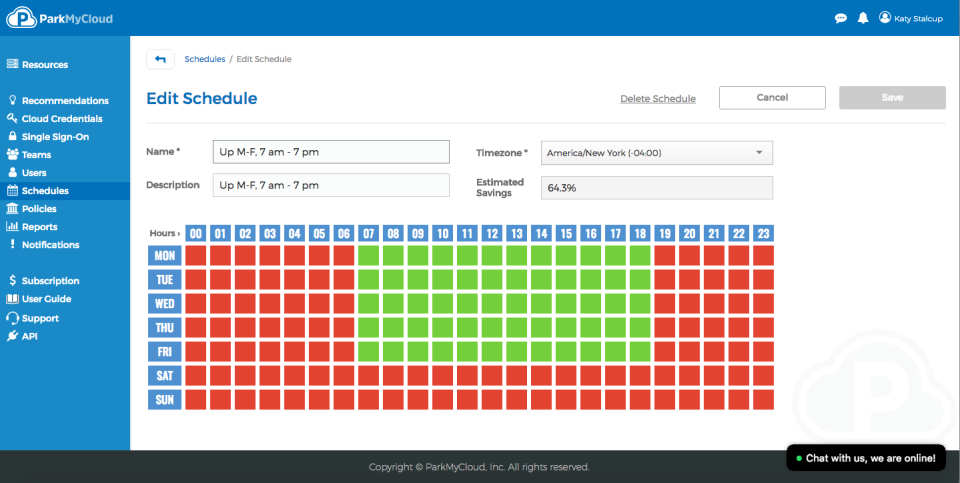
Lots of cloud users can tell a lot about their positive experience with third party platform that has recommended itself as one of the top cloud cost management tools – ParkMyCloud (Turbonomic, recently acquired by IBM). Its so-called Parking Schedule Management was created to add timetables and assign them to required resources in order to use and pay for resources only when you need them.

parkmycloud screenshot

As ParkMyCloud is no longer supported, you might want to know that there is another solution of this kind called CloudAvocado. Its Scheduling capabilities are similar, and additionally, it enables tagging and utilization analytics in your environment to make cost management even more efficient.

cloudavocado aws scheduling screenshot

AWS tagging tools

Tagging is required for the allocation of your cloud costs. Cloud cost allocation is an activity that allows you to connect your AWS bill to specific parts of your product, features or organizational units. The process is straightforward – you assign tags as metadata to all resources to get required reports, analytics and insights per required cost object. Even previously mentioned Scheduling can become quite challenging without proper tagging, as you won’t be able to identify your non-production instances.

Native AWS tools that can help you add and manage your resources’ tags are Tag Editor and AWS Config Managed Rules. Some third-party platforms can also provide you with this functionality, however, you need to be sure the tool can work with your resources across all your accounts. This enables proper tagging across all your regions, projects, etc. and results in accurate and consistent cost allocation.

CloudAvocado works well for tagging also and can also help you to track your tagging progress and display all untagged resources.

untagged resources filter screenshot

Cost and utilization analytics

Your workload needs to be revisioned on a regular basis to detect under- or overprovisioned resources. The former occurs when the capacity of an instance is lower than the demand. It can cause productivity issues within the apps you develop. The latter can cause your cost to be wasted as demand is lower than the instance capacity. It means you can potentially save your budget by replacing it with smaller and cheaper instance/s. The process of matching your capacity to the demand at the lowest possible cost without sacrificing reliability is called rightsizing – and it’s one of the most critical yet complicated tasks in cloud optimization.  AWS provides the following tools to perform this task:

  • AWS Cost Explorer allows you to see patterns in AWS spending over time, project future costs, identify areas that may require your attention. You also should use it for detecting and deleting idle EC2 instances, Amazon RDS instances, Load Balancers and unassociated Elastic IP addresses.
  • AWS Cost and Usage Report provides you with data files that contain your detailed hourly AWS usage across accounts
  • AWS Compute Optimizer helps avoid overprovisioning and underprovisioning using utilization data for some AWS resources (EC2, EBS, ECS), services on AWS Fargate and AWS Lambda functions.
  • Amazon CloudWatch collects and tracks metrics
  • Amazon S3 Analytics – automated analysis and visualization of Amazon S3 storage patterns for cost-efficient tier management of your storage; you also can automate data lifecycle management with Amazon S3 Intelligent-Tiering and reduce Amazon S3 storage cost by identifying cost optimization opportunities with Amazon S3 Storage Lens.

screenshot with bar chart

In the case of third-party tools, some of them cover all the native AWS capabilities mentioned above in a single UI.  

For example, CloudAvocado can easily calculate your current monthly expenses, projected monthly cost and provide you with hourly CPU utilization breakdown for any instance, cluster or autoscaling group. AWS cost and utilization analytics are presented in dashboards and reports to help you make data driven decisions on scaling your workload according to the demand.

cloudavocado dashboard screenshot

Recommendations and alerts for events

Cloud cost optimization tools analyze your cloud usage and spending patterns to identify potential cost-saving opportunities. By providing recommendations, these tools help you react proactively to reduce unnecessary expenses, optimize resource allocation, and eliminate wasteful spending. This can lead to significant cost savings over time. 

AWS Trusted Advisor gathers potential areas for optimization for your workload and AWS Budgets triggers alerts when cost or usage exceeds (or is forecasted to exceed) a budgeted amount.

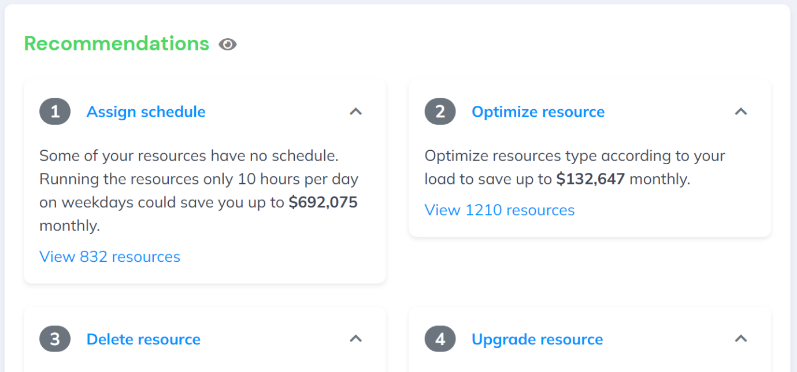
Among many other mentioned functionalities, CloudAvocado has built-in recommendations that highlight different cases of unoptimized usage: idle, unscheduled, untagged resources and resources that produce waste due to over-provisioning.

recommendations screenshot

The verdict

Effective cloud cost optimization is essential for maximizing profitability. Since choosing the right tool can be challenging due to the variety of options available, it’s important to focus on the critical capabilities required for AWS cost optimization first. Look for cost allocation, resource scheduling, and alerts for identifying wasteful spending, and always remember that cost optimization is an ongoing process. 

To get more information about AWS cloud cost optimization tools usage read our article cloud cost optimization checklist.

Or simply sign up for a free CloudAvocado trial to start your AWS cost optimization: get analytics on your AWS spendings, efficiency, and potential savings.